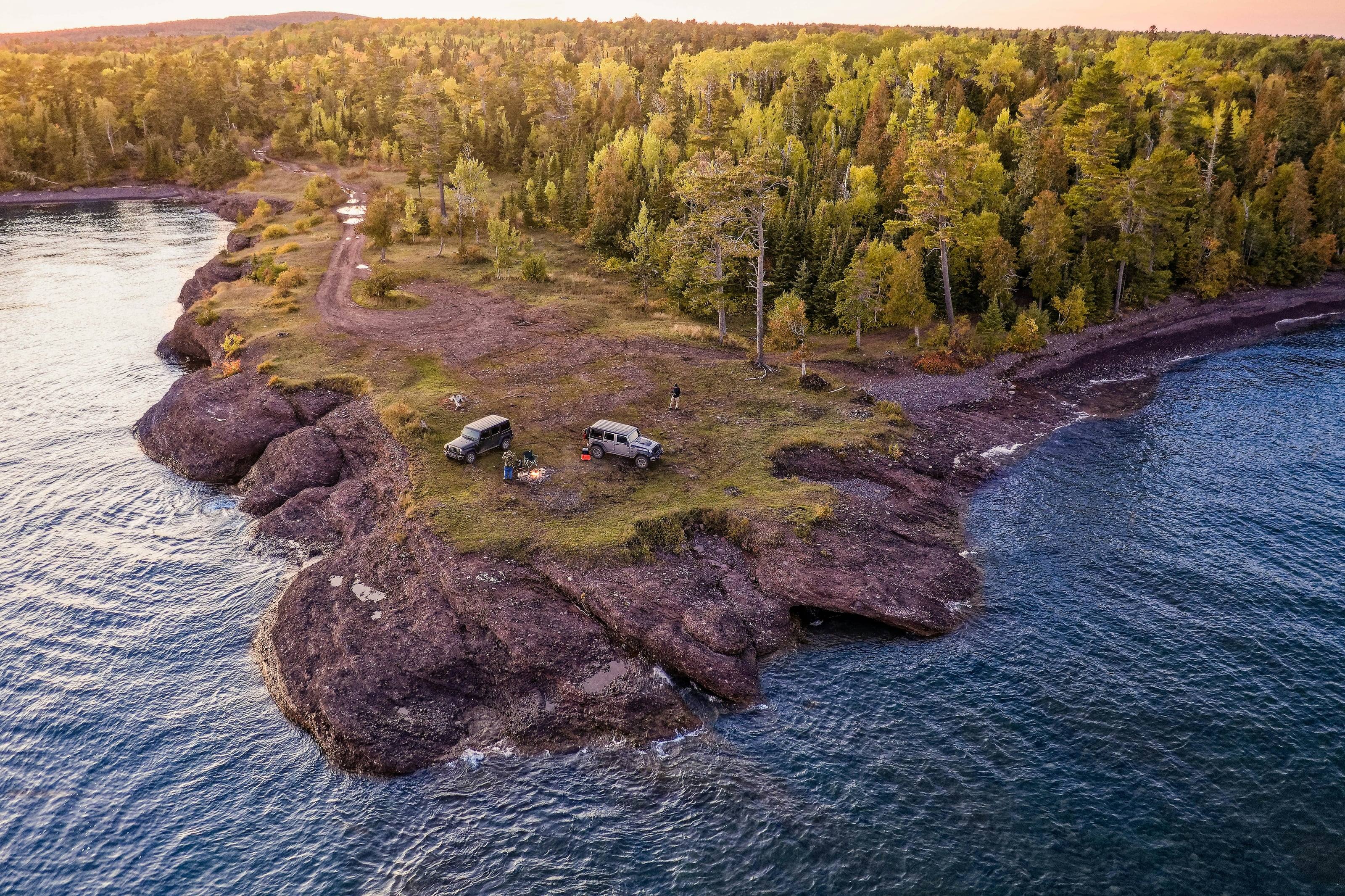
Annual average temperature runs from 50 degrees in the south to 39 in the north
Armor for gravel, not for rock
What a Wisconsin vehicle meets is gravel, sand, standing water and road salt, not granite ledges. The Forest Service says parts of the Dead Horse Run tread sit on wet soils and pool with water, and the same is true of the county forest roads that run beside it. That pushes the work towards sealing, drainage, corrosion protection and stone protection for lines and tanks, rather than heavy sliders for rock.
Racks and carriers get judged by what they do in winter. Anything that traps salt and slush against the body is a problem, and anything that has to be operated in the dark with gloves on had better be simple.
When a catalog part does not exist for your vehicle, does not fit with what you already have, or is not strong enough for what you do, a fabricator builds it. Steel or aluminum, welded, finished, and mounted so the load goes into structure rather than sheet metal.
They also fix what breaks: cracked mounts, bent sliders, torn brackets and the frame damage that ends trips.
Common work
01Bumpers with winch mounts and rated recovery points
02Rock sliders and skid plates
03Roof racks, bed racks and ladders
04Swing-outs for tires, fuel and water
05Mounts for tanks, compressors and batteries
06Frame and bracket repair
How to choose a fabricator
Metalwork is easy to judge if you know where to look.
01Look at the welds, then at how the part mounts. Recovery points and sliders should tie into the frame.
02Ask whether they design in CAD or build to the vehicle, and whether you get drawings.
03Ask about material and finish. Raw, painted and powder coated parts age very differently.
04Ask if they have built for your platform before. Templates and fixtures save you money.
05Ask how a front bumper affects airbag sensors and crush zones. A shop that has done it properly will have an answer.
What to have ready before you ask for a quote
Photographs do most of the talking.
01Clear photos of the vehicle and the area the part mounts to
02What is already mounted there: winch model, lights, tire size
03What the part has to carry, and how much it weighs
04Steel or aluminum, and the finish you want
05A budget range and your timing
Questions people ask
Custom or off the shelf?
If a well-made part exists for your vehicle, it is usually cheaper and faster than custom, and a good fabricator will tell you so. Custom earns its cost when nothing fits, when parts from different makers have to work together, or when you need it stronger or lighter than the catalog offers.
Steel or aluminum?
Steel is stronger for the money, easier to repair in the field and heavier. Aluminum saves real weight on racks, skid plates and boxes, but costs more and needs a welder who works with it regularly. Many builds use both: steel where it hits rocks, aluminum where it just carries things.
Can a fabricator repair a cracked frame or mount?
Often, yes. Send clear photos with your request. A good shop will tell you whether it can be repaired properly or needs replacing.
How high is Wisconsin?
From Sturgeon Bay at 603 feet to Timms Hill at 1,951.
Altitude decides what your engine, your brakes and your lungs have to work with, and how late in the year the passes open.
02,000
Feet above sea level
Towns
Three LakesEnd of the auto tour and the town the 15-mile Heritage Drive Scenic Byway runs east of.1,665 ft
Boulder JunctionVilas County, in the northern part of the Northern Highland-American Legion, close to its rustic campgrounds and boat landings.1,651 ft
Eagle RiverEagle River-Florence Ranger District office. The forest’s Natural History Auto Tour starts here and runs north on US 45.1,647 ft
MinocquaOne of the two towns the DNR names as the heart of the Northern Highland-American Legion State Forest, with Woodruff.1,602 ft
RhinelanderSupervisor’s office for the whole Chequamegon-Nicolet, and the practical service town for the Nicolet side.1,548 ft
GliddenEast end of the Great Divide Scenic Byway, with the Great Divide district’s other office.1,520 ft
Park FallsMedford-Park Falls Ranger District office and the base for the Flambeau Motorized Trail system.1,516 ft
MedfordSouthern gateway to the Chequamegon side, on WIS 13 and WIS 64. Both Perkinstown trailheads are reached from here.1,474 ft
FlorenceNortheast corner of the state, with a ranger district office and the forest’s Wild Rivers Interpretive Center.1,301 ft
HaywardWest end of the Great Divide Scenic Byway and one of the two Great Divide Ranger District offices.1,193 ft
St. Croix FallsOn the St. Croix at the Minnesota line, by the Saint Croix National Scenic Riverway and the Governor Knowles State Forest.923 ft
Black River FallsBeside I-94 at the Black River State Forest, where 34 miles of state forest ATV trail join the Jackson and Clark county systems.794 ft
BayfieldHeadquarters of Apostle Islands National Lakeshore, on the Lake Superior byway. The islands themselves are reachable only by water.656 ft
AshlandThe Lake Superior byway leaves US 2 near here and runs up WIS 13. Home of the Northern Great Lakes Visitor Center on the national forest.648 ft
Prairie du ChienWhere the Great River Road meets the west end of the Lower Wisconsin River Road, on the Mississippi.641 ft
Sturgeon BayStart of the Door County Coastal Byway, which splits north of town onto WIS 42 and WIS 57.603 ft
Passes, high roads and summits
Timms HillThe highest point in Wisconsin, in Price County. The USGS publishes 1,951 feet; our own reading of the elevation surface gives 1,9521,951 ft
Sugarbush HillA named summit in Forest County, on the Nicolet side. Measured here from the national elevation surface at the summit’s map coordinates1,936 ft
Rib MountainThe high ridge above Wausau in Marathon County. Measured from the national elevation surface1,917 ft
Mount WhittleseyA named summit in Ashland County, in the high country south of Lake Superior. Measured from the national elevation surface1,873 ft
Saint Peters DomeA named summit in Ashland County, on the Chequamegon side. Measured from the national elevation surface1,561 ft
Pass, road and summit elevations are the figures published by the agency that manages them. Town elevations are the town’s or county’s own
figure where it publishes an exact one; the rest are from the U.S. Geological Survey (3D Elevation Program at the place’s official coordinates),
retrieved September 18, 2026. Every source is listed at the foot of the page.
Free build quotes
Looking for fabricators in Wisconsin? Tell us about the project and get free quotes.