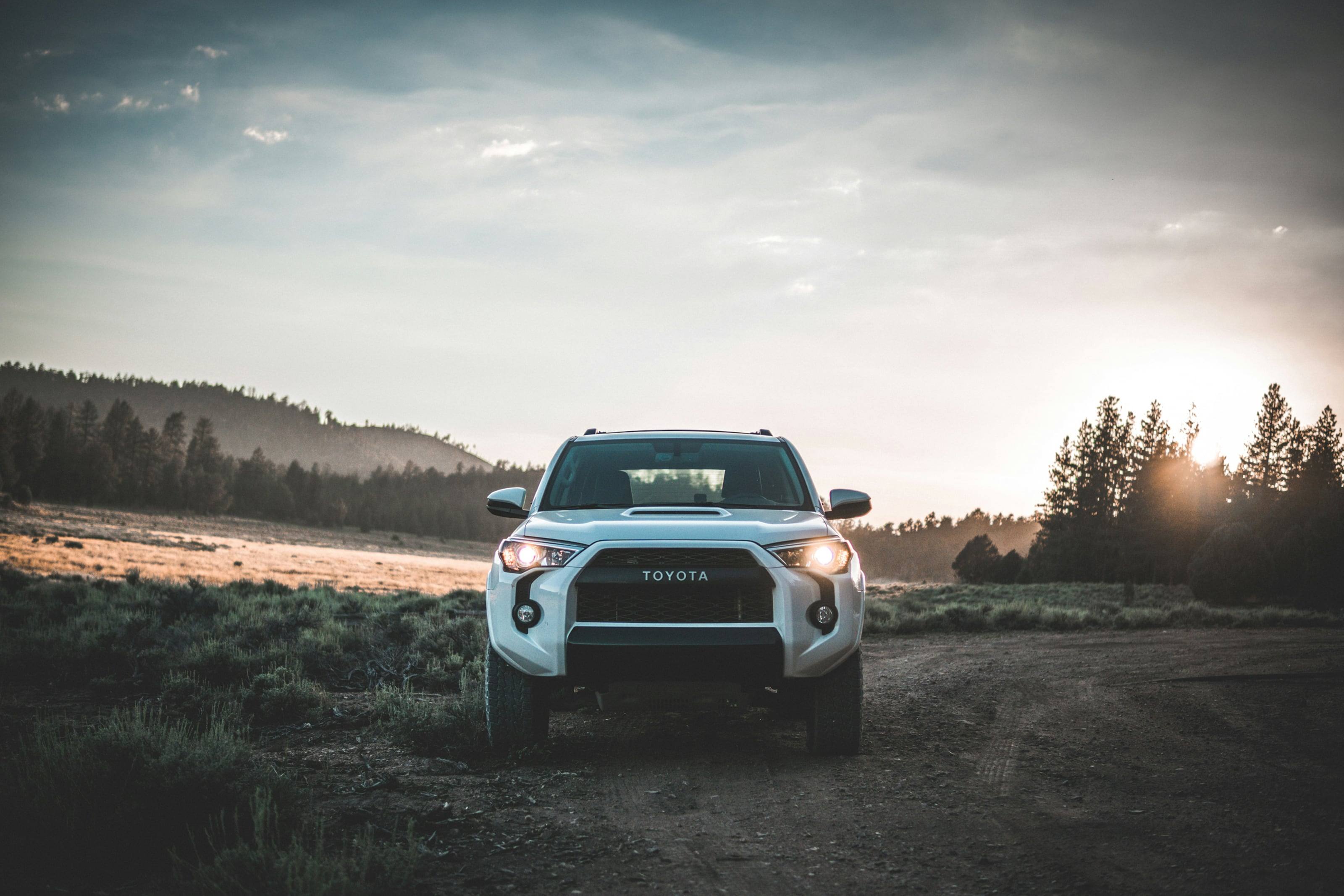
The 4Runner has been a body-on-frame wagon with a low range for six generations, and the current one sits on the TNGA-F truck platform it shares with the Tacoma, Land Cruiser, Tundra and Sequoia. Toyota now sells it in nine grades, two of which are built around travel rather than speed.
That range of grades is the thing to understand before shopping. Ground clearance, approach angle, curb weight and towing capacity all move with the badge on the tailgate, and so does the payload you have left for a build. This guide gathers what Toyota publishes for the current United States model and puts it in the order a traveler needs it.
What the current 4Runner does well for travel
Toyota builds every grade on reinforced body-on-frame construction with a high-strength boxed-steel ladder frame, with a double-wishbone front suspension and a coil-sprung multi-link rear. That is the part you cannot add later, and it is the reason the platform tolerates a loaded life.
Four-wheel drive comes two ways. Most 4WD grades use a part-time system with an electronically controlled two-speed transfer case and active traction control. Platinum, Limited 4WD and Limited i-FORCE MAX use full-time four-wheel drive with a Torsen limited-slip center differential that locks. The TRD Off-Road grades, Trailhunter and TRD Pro add an electronically controlled locking rear differential with Multi-Terrain Select, Crawl Control and Downhill Assist Control, and Trailhunter and TRD Pro add the Stabilizer Disconnect Mechanism for more articulation at low speed.
Two standard items deserve more attention than they get. Every grade has front and rear recovery points from the factory, and every grade has an integrated hitch receiver with four-pin and seven-pin connectors. Hybrid grades add two 120-volt, 2400-watt outlets in the rear seat and cargo area, where the gas grades get 400-watt outlets, which is enough to change how you think about camp power.
The Trailhunter grade is Toyota building an expedition truck in the factory: steel skid plate and transfer case protector, a rear differential protector, frame-mounted steel rock rails, a roof rack, a high-mount air intake, an onboard high-output air compressor, four prewired auxiliary switches and 18-inch wheels on all-terrain tires.
Source 1
What it asks of you: payload, and what goes on the roof
Toyota does not publish a payload figure for the 4Runner in its own specification tables. The owner’s manual publishes the number that governs instead, and it is sobering.
Vehicle capacity weight, which is occupants and luggage combined, is 895 lb. on models without a third row and 1,160 lb. on models with one. Put two adults in the front seats and roughly a third of the smaller figure is gone before a bag is loaded. Everything after that competes for the same allowance: water, fuel, recovery gear, a fridge, a drawer system, a bumper, sliders, a tent.
That is not a flaw in the vehicle. It is the reason a 4Runner build is an exercise in subtraction. Decide what earns a place, weigh the result, and be honest about what a second passenger costs you.
Source 2
The roof is the tightest limit on the vehicle
Toyota limits roof luggage carrier cargo to 125 lb. on two-wheel-drive models and 135 lb. on four-wheel-drive models. Many popular hard-shell roof tents weigh more than that before the rack, the bedding or a person is added.
The manual also gives the method for the rest of the load: locate the combined weight statement for occupants and cargo on the vehicle placard, subtract the weight of the people who will ride, and treat what is left as the cargo and luggage allowance. If you tow, load from the trailer transfers to the vehicle and reduces that allowance again.
Read those two limits together and the shape of a sensible 4Runner build appears. Keep weight low and inside the body, use the roof for bulky light things, and put sleeping arrangements on the ground or behind the vehicle rather than above it.
Do not skipToyota’s warning with the roof limit is about behavior, not just weight. Cargo on the roof raises the center of gravity, so avoid high speeds, sudden starts, sharp turns, sudden braking and abrupt maneuvers, any of which can lead to loss of control or a rollover.
Source 3
The generations worth knowing
Toyota counts six. The first ran from 1984 to 1989, the second from 1990 to 1995, the third from 1996 to 2002, the fourth from 2003 to 2009 and the fifth from 2010 to 2024, which is the longest run of the six and the reason so many capable used examples exist. The sixth generation arrived for 2025.
One detail has survived every one of them. Toyota still fits a power rear window that raises and lowers with a switch, and calls it a signature element found across all generations of 4Runner. For a traveler it is a genuinely useful door: long items, a dog, and ventilation without opening the tailgate.
For the current truck, Toyota describes the TNGA-F chassis as body-on-frame construction with a boxed frame, chosen for toughness, rigidity and rust protection.
Source 4
Weight decides everything, so weigh the truck
Gross vehicle weight rating runs from 6,005 lb. to 6,505 lb. depending on grade, and curb weight from 4,455 lb. to 5,500 lb. A heavier grade does not always mean more capacity, because the two numbers move together.
Weigh the vehicle empty, then weigh it loaded the way you travel, with water and fuel aboard and passengers in their seats. Public scales at a truck stop or a landfill will give axle weights for a small fee. Compare total weight against the gross vehicle weight rating and each axle against its own rating, because a 4Runner with a rear bumper, a spare tire carrier and a drawer system full of tools can sit inside the total and still overload the rear axle.
A weighed truck makes every later decision cheaper. Spring rates can be specified for a real load, tires chosen by load index against measured axle weights, and brake and cooling behavior judged against the vehicle you actually drive down a pass.
Source 1
The upgrades that matter, in the order most owners need them
Work down this list rather than across it, and re-weigh after anything heavy.
The order that wastes the least money
- 01Tires, in the size the vehicle was designed around, with a load index suited to your measured axle weights. Most 4Runner grades carry a full-size spare under the body, so keep it matched.
- 02A way to air down and air back up. On grades without the factory compressor this is the first accessory that earns its space.
- 03Suspension matched to the finished weight, after the build is weighed rather than before.
- 04Protection where your grade lacks it. TRD Off-Road grades have a composite front skid plate with transfer case and fuel tank protection, and Trailhunter adds steel; other grades and the rocker panels are where the gaps usually are.
- 05Recovery points are already fitted front and rear on every grade, so the money belongs in what attaches to them and in training to use it.
- 06Power and storage last. Hybrid grades already carry 2400-watt outlets, so size a battery to what you actually run, and choose drawers with the capacity weight figure in front of you.
Source 1
Maintenance before a long trip
Toyota asks for scheduled maintenance every 5,000 miles or six months, whichever comes first, and then adds items for what it calls special operating conditions.
Dirt and dusty roads trigger inspection of ball joints and dust covers, drive shaft boots, the engine air filter, steering linkage and boots and propeller shaft boots at every 5,000-mile interval, plus torquing of the propeller shaft bolts and the chassis and body fasteners. Towing, a car-top carrier or heavy vehicle loading adds front and rear differential oil, transfer case oil and transmission fluid service. A vehicle driven mainly on dirt or dusty roads takes engine oil and filter every 5,000 miles or six months instead of the longer default.
After a day off-road through deep sand, mud or water, Toyota asks for daily inspections: ball joints and dust covers, brake lines and hoses, brake linings, drums, pads and discs, differential oil, drive shaft boots, the engine air filter, chassis and body fasteners, propeller shaft boots, steering linkage and boots, transfer case oil and transmission fluid, and torquing of the propeller shaft bolts. That list is also a sound pre-departure inspection.
Source 5
Finding a specialist, and checking for recalls
A 4x4 shop or an overland builder is the right first call for suspension, lockers, gearing and the coordination of a whole build. A fabricator makes and fits bumpers, sliders, racks and drawer systems. An overland mechanic looks after the drivetrain, cooling and electrical systems between trips. For tires, look for a shop that asks what the vehicle weighs before recommending anything, and that will fit a spare to match.
Recalls are the one kind of known problem worth checking yourself before a trip. The federal safety regulator publishes a lookup by vehicle identification number that shows unrepaired recalls for a specific vehicle, and it states that the search will not show recalls already repaired, some recently announced recalls for which not every vehicle identification number has been identified, or safety recalls more than 15 years old.
Whoever does the work, ask for the torque figures and keep the paperwork. A build is easier to maintain when someone wrote down what was done to it.
Source 6
Questions people ask
How much can a 4Runner carry?
Toyota does not publish a payload number in its specification tables, but the owner’s manual gives a vehicle capacity weight for occupants and luggage combined, and on models without a third row it is well under half a ton. Read the label inside your own door and plan from it.
Can I put a roof tent on it?
Check the roof limit first. Toyota permits a modest cargo weight on the roof luggage carrier, and many hard-shell tents exceed it before the rack and bedding are counted. A ground tent, an awning or a trailer keeps the weight where it belongs.
Which grade should I buy for travel?
The off-road grades bring a locking rear differential, terrain modes and better angles, and Trailhunter adds protection, a compressor and auxiliary switches from the factory. The trade is weight and cost. If you plan to add all of that anyway, buying it built tends to be tidier than bolting it on.
Hybrid or the turbo four?
The hybrid brings more torque and the larger inverter outlets, and it weighs more, which comes out of your load. The turbo four is lighter and simpler. Either will do the driving; the deciding factor is usually what you want to run at camp.
What should I fix before a long trip?
Work through the manufacturer list for dirt and dusty roads: boots, ball joints, the air filter, driveline fasteners and fluids. Then check pads, coolant, the spare and the torque on anything bolted on since the last trip.