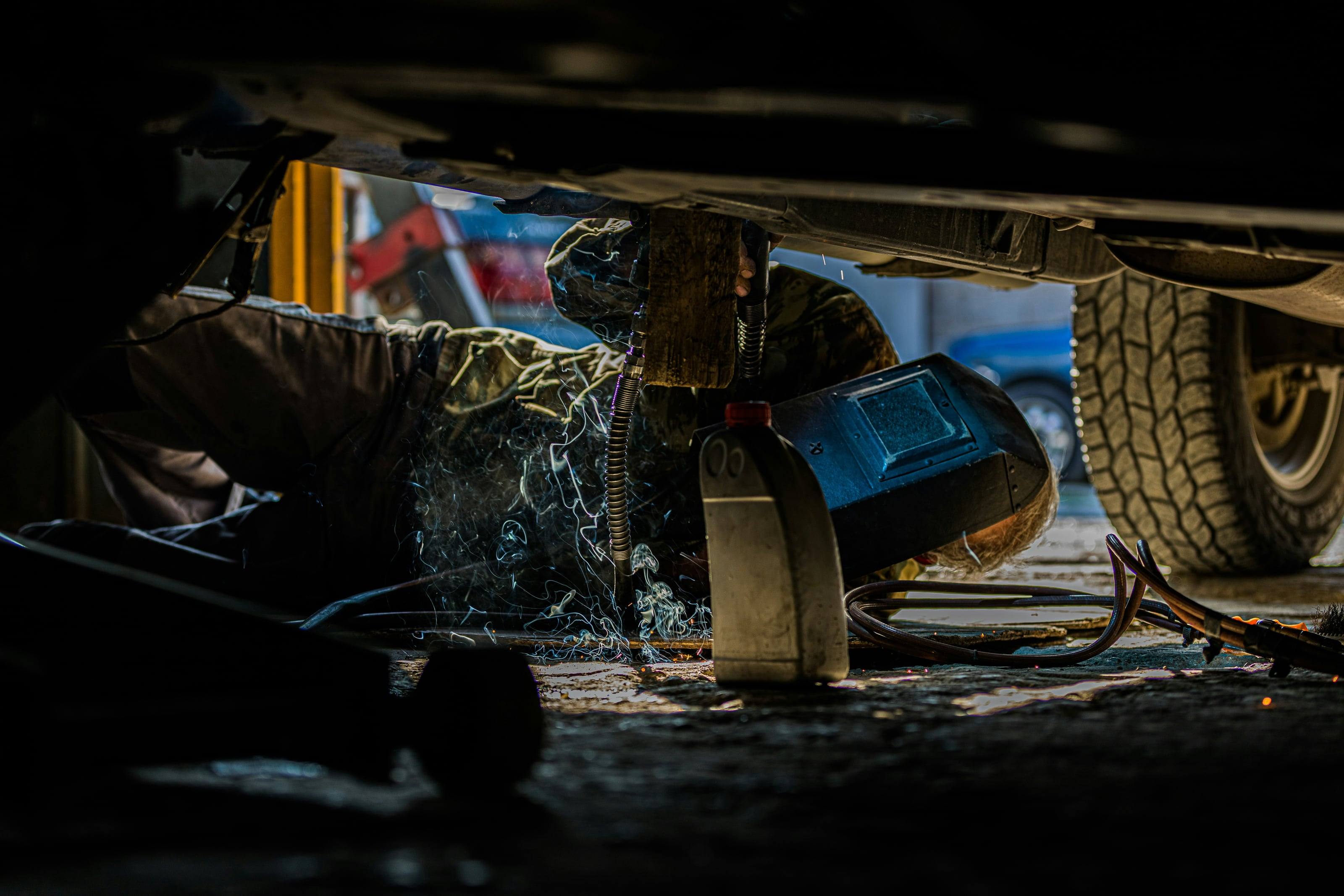
Most breakdowns on a trail are small: a puncture, a flat battery, a split hose, a blown fuse, a bolt that has shaken loose. They become serious because of where they happen. Death Valley National Park warns that on its backcountry roads rescue is likely to be extremely delayed, that towing charges are high, and that auto club cover often does not extend to tows on dirt roads.
A trail repair has one job: get the vehicle to a shop under its own power without hurting anyone. This guide covers the fixes worth knowing, the kit behind them, and the point where the right tool is a satellite messenger. Reading it is not training. Practice each of these in your driveway, and take a course if you can.
What a trail repair is for
The Park Service puts the principle plainly for one of its most remote monuments: you are responsible for your own safety and you must be able to self-rescue. Rangers at Grand Canyon-Parashant say most of their rescues involve vehicles with multiple flats, and the rest are stuck, high-centered or broken down. They recommend two all-terrain spares, because the rock that opens a front sidewall often opens the rear one a moment later.
Three rules apply. Make the scene safe before you touch the vehicle. Find the cause before you fix the symptom. Fix only as much as it takes to drive out slowly, because every field repair gets redone properly at a shop.
Source 1
The kit that makes repairs possible
A tool you have never used is cargo. Change a wheel at home with the vehicle's own jack, plug a scrap tire, and find the fuse boxes, jump-start points and jacking points in the owner's manual before you need them. An overland mechanic or 4x4 shop can tell you which spares suit your platform, and a trail repair course lets you practice with someone watching.
Big Bend National Park's list for its backcountry roads is a sound core: a good spare tire, a tire repair kit and pump, extra belts and hoses, tools to change tires, and extra coolant or water for the radiator, plus a shovel.
A working trail kit
- 01Tires: a full-size spare at road pressure, plug kit, compressor, gauge and valve cores.
- 02Lifting: the jack that fits your jacking points, a base for soft ground, chocks, a lug wrench and the wheel lock key.
- 03Electrical: a jump pack or cables, spare fuses in every rating, a test light, wire, connectors and tape.
- 04Fluids: engine oil, coolant or water, and what your manual specifies for brakes and steering.
- 05Hoses and belts: self-fusing tape, hose clamps, and the spare belt and hoses for your engine.
- 06Fasteners: nuts and bolts in your sizes, thread locker, zip ties, steel wire and a ratchet strap.
- 07Hand tools that fit your vehicle, gloves, eye protection and a headlamp.
Source 2
Jacking safely on uneven ground
A vehicle on a jack is the most dangerous moment in any trail repair, and soft ground makes it worse. Ford's manual tells drivers never to place anything between the jack and the ground, which is written for pavement. The Park Service sees it differently for sand and rock: Grand Canyon-Parashant recommends a jack with a base that can be set up on rocky or sandy ground. Settle this at home. Carry a jack and a base made to work together, and check that the jack still reaches with your tires and suspension.
The rules below are from Ford's 2024 Bronco manual. Read your own.
Before the wheel comes off
- 01Use the jack on level, firm ground wherever possible. That can mean driving slowly on the flat to a better spot.
- 02Transmission in park or in gear, parking brake fully on, engine off.
- 03Chock the wheel diagonally opposite the one you are lifting.
- 04Everyone out. Nobody stays in a vehicle that is being jacked.
- 05Lift only at the jacking points the manual shows.
- 06Loosen the wheel nuts before the wheel leaves the ground, and tighten them fully only after it is back down.
- 07Lift no higher than the job needs, and slide the spare or the flat under the frame while a wheel is off.
Do not skipNever put any part of your body under a vehicle held up by a jack. Ford's manual says do not get under a vehicle that is supported by a jack, and do no other work on it while it is, because the vehicle could slip off. If a repair needs you underneath, the vehicle needs to be on the ground or on a tow truck.
Source 6
Tires: the plug and the spare
A string plug pushed in from outside works on a clean puncture in the tread. Leave the nail or thorn in until you are ready, then pull it, ream the hole along the same angle, push the plug in, trim it, inflate, and check it with soapy water. Drive slowly and check the pressure again soon.
Know what that fix is. The U.S. Tire Manufacturers Association accepts a repair only when the tire comes off the wheel for inspection inside, the damage is in the tread area, the puncture is no larger than 1/4 inch, and the hole is both plugged and patched from the inside. It calls a plug alone an unacceptable repair. A trail plug is a way to reach a tire shop.
Damage in the shoulder or sidewall cannot be repaired. Fit the spare. That only works if the spare holds air, so follow NHTSA and check it with the other tires every month.
Source 4
Battery and jump starting
A flat starter battery is usually a fridge, lights or a door left open. With a jump pack, Ford says to follow the pack maker's instructions. If the battery goes flat again, look for a charging fault or a drain.
With cables, the order of connection matters. This is Ford's sequence for the 2024 Bronco. Your manual shows where the terminals and ground point are on your vehicle, and they are often not at the battery.
Connecting jumper cables
- 01Positive cable to the positive terminal of the flat battery.
- 02Other end of the positive cable to the positive terminal of the good battery.
- 03Negative cable to the negative terminal of the good battery.
- 04Last: negative cable to the ground point, or to bare engine metal on the dead vehicle, away from the battery and the fuel system.
- 05Start the dead vehicle, run both for three more minutes, then remove the cables in reverse order.
Do not skipBatteries give off explosive gas. Ford's precautions for this procedure: keep sparks and flames away, shield your face and eyes, connect only batteries of the same voltage, use cables with insulated clamps, keep them clear of moving parts, and never jump or charge a battery that has been frozen.
Source 7
Fluids and hoses
When the temperature gauge climbs or a warning shows, stop as soon as it is safe. Let the engine cool, then look for the cause: a split hose, a loose clamp, a holed radiator, a lost belt, or mud packed into the radiator.
A split hose can often be dried, wrapped well past the split with self-fusing tape and clamped. Refill and watch the gauge. Ford's manual allows plain water in an emergency to reach a service location, and warns that water alone can lead to corrosion, overheating or freezing. It also tells Bronco owners not to use stop-leak pellets or cooling system sealants, so read your own manual before pouring anything in.
Ford's wording on fluids is that they are not interchangeable, so carry what your manual specifies. Loss of brake fluid is not a trail repair. It is a tow.
Do not skipNever open a hot cooling system. Ford's instruction is not to remove the cap while the engine is on or the system is hot: wait 10 minutes for it to cool, cover the cap with a thick cloth, and open it slowly to prevent scalding.
Source 9
Fuses, wiring and fasteners
Something electrical that stops working on a rough road is usually a fuse, a connector or a wire that has rubbed through. Find the fuse diagrams in the manual, pull the fuse for the dead circuit and look at it. If it has blown, ask why before you replace it.
A chafed wire can be taped, moved off the edge that cut it and tied down. If a new fuse blows at once, the short is still there, so leave that circuit dead.
Washboard undoes fasteners. After a rough day, put a wrench on the wheel nuts, shock mounts, skid plates, rack feet and battery hold-down. A part that has lost its mount can be strapped or wired in place for a slow drive out. After any wheel change, tighten the wheel nuts again at the distance your manual gives.
Do not skipReplace a fuse only with one of the same amperage. Ford's manual warns that a fuse with a higher rating can cause severe wire damage and could start a fire, and says to disconnect the battery before servicing high current fuses.
Source 10
A bent tie rod, and when to stop and call for a tow
Hit a rock with a front wheel and the usual casualty is a tie rod, the bar that points the wheel. It looks bowed, the steering wheel sits off center, and the front tires scrub. No vehicle maker we found publishes a field fix for a bent steering part, and this guide will not invent one. What matters is the decision.
If the rod is bowed but not cracked or kinked, the joints at each end are tight, and the steering turns lock to lock without binding, drivers do crawl out at walking pace to the nearest place a trailer can reach, checking the part at every stop. A bent rod is a weakened rod, so have it replaced and the alignment checked before driving at road speed.
Death Valley's advice for a breakdown is to stay with the vehicle, and to leave the hood up or mark the road with a large X visible to aircraft. Most of that park has no cell reception, which is why the Park Service recommends a satellite messenger for remote roads.
Stop and call for help when
- 01The steering binds, has new free play, or a steering or suspension part is cracked or broken.
- 02The brake pedal sinks, or brake fluid is leaking.
- 03Fuel is leaking.
- 04The engine overheats again after your repair, or loses oil pressure.
- 05The repair would put you under a vehicle on a jack.
- 06You are out of daylight, water or ideas.
Do not skipSteering and brakes are the two systems you do not improvise on at road speed. If either is in doubt, the vehicle leaves on a trailer.
Source 3
Questions people ask
Is a plugged tire safe to keep driving on?
As a way to reach a tire shop at modest speed, watching the pressure, yes. As a permanent repair, the tire industry says no: a plug alone is not an acceptable repair, and the tire needs to come off the wheel to be inspected inside, then plugged and patched or replaced.
Can I use the factory jack off-road?
Often, if you have tested it. It is made for the jacking points on your vehicle and for firm, level ground. Bigger tires or a lift can leave it short, and sand will swallow its small foot. Try it at home on the tallest corner, and sort out a base for soft ground that your manual and the jack maker allow.
Jump pack or jumper cables?
A jump pack works when you are alone, which is when it matters. Cables never go flat but need a second vehicle. Many travelers carry both. Ford's manual says to follow the pack maker's instructions, and the connection order for cables is in your own manual.
Will roadside assistance come and get me?
Do not count on it. Death Valley National Park warns that towing charges are high and that auto club cover often does not extend to tows on dirt roads. Read your policy before the trip, find out who does backcountry recovery in the area, and carry a satellite messenger so you can ask.
Which spare parts are worth carrying?
The ones that fail on your platform and that you can fit beside a trail: belts, hoses, fuses and relays, wheel studs and nuts, and for hard use a tie rod. An overland mechanic who knows your vehicle can shorten that list to what actually breaks.