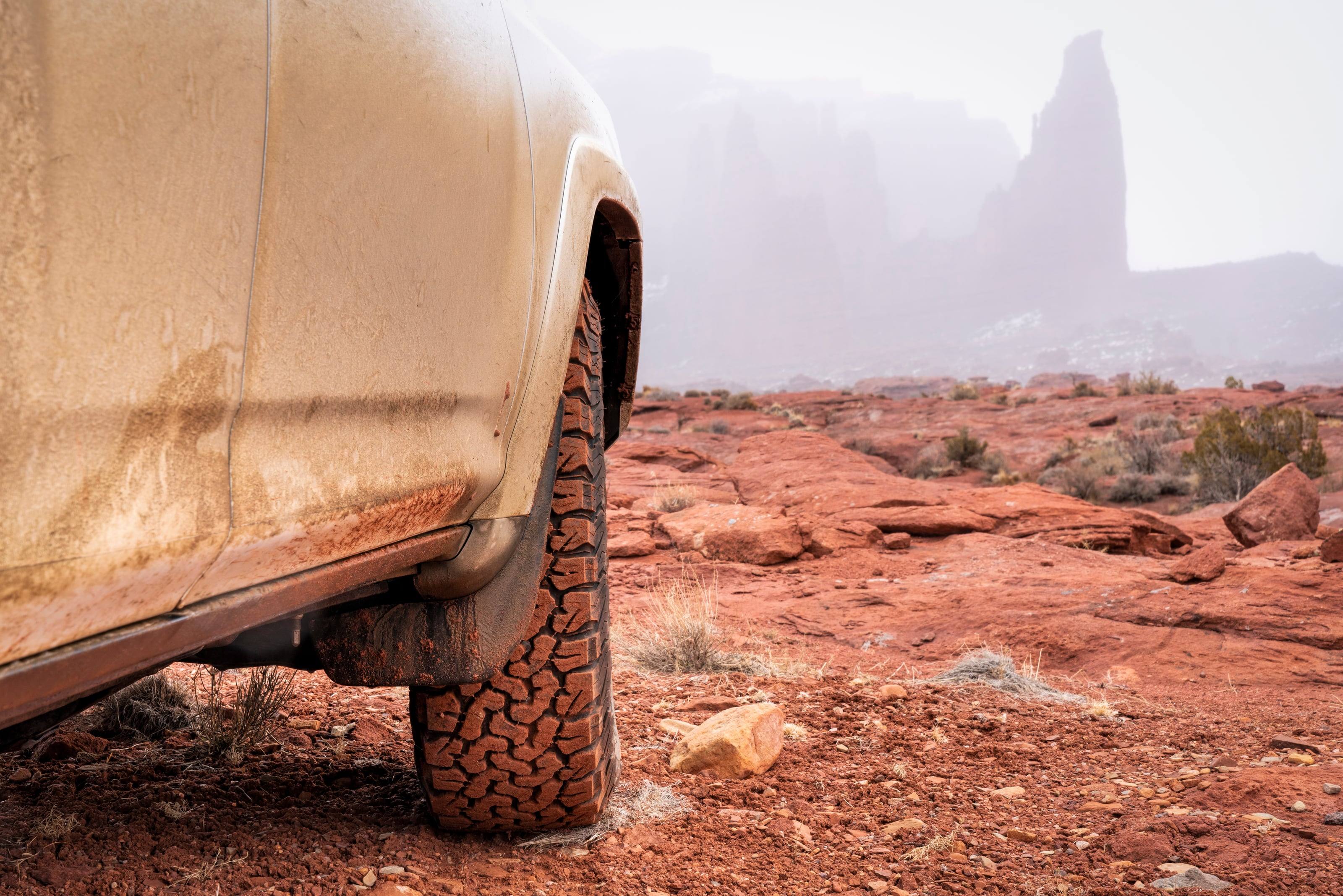
Tire pressure is the cheapest change you can make to how a vehicle behaves off pavement. A softer tire spreads the load over more ground, wraps around what it rolls over and takes the edge off washboard.
It also takes the tire away from the pressure it was designed to carry your vehicle at on the road. That is why every figure on this page comes from the National Park Service, NHTSA, the tire industry or a vehicle maker, and why there is no single right number. Reading this is not training. A day with an instructor on the surface you plan to drive is worth more than any chart.
What lower pressure does to a tire
A tire at road pressure is a stiff hoop with a short contact patch. Let air out and the patch grows, mostly in length. BFGoodrich describes the result: a bigger footprint for better traction on soft or uneven ground, and a smoother ride over bumps and rocks.
The same tire maker is clear that there is no universal number. The right pressure depends on the tire, the terrain and the weight of the vehicle. Your road pressure is on the placard in the driver's door jamb. If you have changed tire size or type, BFGoodrich says the placard no longer applies and the pressure should be worked out with a tire professional.
So think of a reduction from your own road pressure, for one surface at one speed, made in stages and checked with a gauge you trust.
Source 7
Sand: staying on top
Sand is a flotation problem. A long, soft footprint keeps the vehicle on top. A hard tire cuts in and digs.
Sand is also where the Park Service publishes numbers. Cape Hatteras National Seashore tells drivers that pressure must be lowered to keep adequate traction, recommends less than 20 psi for most vehicles, and adds that the softer the sand, the lower the pressure needed. Cape Lookout recommends 20 to 25 psi, and Great Sand Dunes about 20 psi for the soft sand on the Medano Pass road. BFGoodrich's Australian 4WD guide is more cautious: lower in steps of 5 psi until the footprint is right, and do not go below 20 psi. Treat all of these as starting points for ordinary vehicles at low speed, not as targets.
Hatteras pairs its advice with a limit of 15 mph unless otherwise posted, and the pairing is the lesson: low pressure and low speed go together.
Drive sand with steady throttle, wide turns and gentle braking. Park pointing downhill or on firm ground so you can pull away. If the vehicle bogs, stop at once and let out a little more air before you reach for the shovel.
Source 2
Washboard and rock: letting the tire do some of the work
On corrugated gravel a tire at road pressure skips from crest to crest. Fasteners loosen, and steering and braking go vague because the tires spend part of the time in the air. A modest reduction lets the tire absorb the corrugations and stay on the ground. It does not make washboard safe at speed.
On rock the gain is grip and survival. Rangers at Grand Canyon-Parashant National Monument explain that a tire at high pressure is so rigid it cannot flex over rocks, so it ruptures instead. They note that many pickups come with pressures up to 75 psi, that many off-road drivers run well under 40 psi on rough roads, and that they refill to the recommended pressure on returning to pavement.
Rock pressure is not sand pressure. Great Sand Dunes tells drivers who aired down for the sand to reinflate before the rocks in Medano Canyon. A very soft tire lets the rim and the sidewall reach what the tread should be meeting.
Source 4
The risks: bead, sidewall, heat and speed
Everything that makes a soft tire work also makes it vulnerable.
- 01Bead. Air pressure holds the tire on the rim. BFGoodrich warns that too little can unseat it and cause serious damage. Sharp steering and side slopes are where beads let go.
- 02Sidewall. A soft tire bulges, and the bulge is the thinnest part of the tire. Sidewall damage cannot be repaired. Pick lines that keep sidewalls off rock edges.
- 03Heat. The U.S. Tire Manufacturers Association says underinflated tires generate excessive heat build-up and stress, causing irregular wear and internal damage. Heat rises with speed, load and distance.
- 04Speed. BFGoodrich Australia advises that at 20 psi it is best not to go faster than 25 km/h, about 15 mph, and then not for long distances. A soft tire also steers late, rolls in corners and takes longer to stop.
- 05Warnings. The Association says pressure monitoring systems warn when a tire is 25% underinflated, so expect the light.
Do not skipAn aired-down tire is a low-speed tire. The tire industry warns that underinflation causes heat build-up and internal damage, and BFGoodrich adds that underinflated tires run hotter, increasing the risk of blowouts. Keep speeds low while aired down, and air back up before the road.
Source 5
Airing back up before pavement
Air back up before you return to pavement, not at the first gas station down the highway. BFGoodrich says tires aired down for off-road use must be reinflated before driving on paved roads, and Cape Lookout National Seashore warns that on paved roads low pressure can affect braking and maneuverability.
That means carrying your own air. Great Sand Dunes runs a free air station near the Medano Pass road in the warmer months and still advises drivers to bring their own compressor. Carry a compressor sized to your tires, a gauge that reads accurately at low pressures, and a way to let air out evenly.
The target is the vehicle maker's cold pressure. NHTSA says to take it from the Tire and Loading Information label on the driver's door edge or post, not from the number on the tire, and defines cold as not driven for at least three hours. At the end of a trail your tires are warm. NHTSA's advice for warm tires is to fill to the placard figure, treat that as a temporary fix, and recheck when you can get a cold reading.
Source 6
Reading the surface, and momentum versus wheelspin
Traction is a supply, and the surface tells you how much there is. Ford's off-road guidance for the Bronco tells drivers to look ahead for changes in surface texture or color that may indicate a change in available traction, and to get out and check the terrain where necessary. Darker sand is usually damp and firmer. Pale, rippled sand is soft. Shiny clay is slick. Walk anything you are unsure of.
Momentum is steady speed carried across a soft patch so the tires never have to claw for grip. The same manual says to drive through sand without varying speed, use momentum to keep moving, avoid excessive wheel slip, and avoid stopping on steep sand slopes. Momentum is not speed for its own sake, and it has no place on rock, where slow and placed beats fast every time.
Wheelspin is the opposite: the tire moving faster than the vehicle, polishing mud, digging sand and breaking parts when it suddenly grips. On hills, Ford says to apply just enough accelerator for the wheels to climb, because too much makes the tires slip, spin or lose traction. When progress stops, stop. Back out along your tracks, lower the pressure or change the line, and try again.
Source 9
Lockers and traction control in plain words
An ordinary open differential lets the two wheels on an axle turn at different speeds, which is what makes cornering possible. Its weakness is that drive goes to the wheel that is easiest to turn. Lift one wheel, or put it on ice, and that wheel spins while the one with grip does nothing.
Traction control fixes this with the brakes. It notices the spinning wheel and brakes it, which pushes drive across the axle to the wheel with grip. It needs a little wheelspin to work and it may cut engine power, which is why many 4x4s have off-road modes that change how it behaves. Hold a steady throttle and let it work.
A locking differential fixes it mechanically. Ford's manual describes one as a device that, when activated, allows both wheels on that axle to turn at the same speed, for mud, rocks, sand or any off-road condition where maximum traction is needed. It is not for dry pavement, where Ford warns of tire wear, noise, vibration or driveline damage, and a locked front axle resists steering and widens turns. Engage a locker before the obstacle, keep the wheels as straight as you can, and unlock it afterward.
None of these creates grip. They only stop a spinning wheel from wasting it. Tires at the right pressure come first.
Source 10
How to practice, and where to learn
Find a legal, easy stretch of sand or a rough gravel road and run an experiment. Drive it at road pressure. Drop the pressure in stages, checking with a gauge, and drive it again each time. Time how long your compressor takes to refill four tires, because that decides how willing you will be to air down on a real trip.
Practice pulling away gently on a loose climb: first with everything open, then with traction control working, then locked if you have a locker. A driver training course does all of this with an instructor in the passenger seat, and a good tire shop can work out sensible road pressures for a loaded vehicle on non-standard tires.
Questions people ask
What pressure should I air down to?
There is no single number, and the tire makers say so themselves. It depends on the tire, the load, the surface and the speed. The Park Service publishes starting points for three of its sand routes, shown in the figures at the top of this guide. For rock and washboard, reduce in stages from your own road pressure, keep speeds low, and go no lower than the surface needs.
Do I need beadlock wheels?
Only if you run very low pressures often. BFGoodrich says beadlock wheels can help prevent a tire unseating if you air down often or to very low levels. For moderate reductions at low speed on ordinary wheels, smooth steering matters more.
How fast can I drive on aired-down tires?
Slowly. BFGoodrich's Australian 4WD guide says that at 20 psi it is best not to go faster than 25 km/h, about 15 mph, and not for long distances, to keep the tires from overheating. Cape Hatteras posts a 15 mph limit on the beach routes where it recommends low pressures. Heat is the enemy, and heat comes from speed, load and distance.
Can I drive home without airing back up?
No. BFGoodrich says tires aired down for off-road use must be reinflated before driving on paved roads, and the tire industry warns that underinflation causes heat build-up and internal damage. Carry a compressor. If it fails, the advice from BFGoodrich Australia is to drive very slowly and not for long distances.
Should I lock the differential before or after I get stuck?
Before. A locker works best engaged ahead of the obstacle with the wheels straight. Locking up after the wheels have dug holes mostly digs them faster. Unlock once you are through, and never run locked on dry pavement.
Why did my tire pressure warning light come on?
Because it is doing its job. NHTSA says the light means at least one tire is significantly underinflated, which is exactly what airing down does, and that it goes out once the tires are properly inflated. If it stays on after you air up, check every tire with a gauge, the spare included.