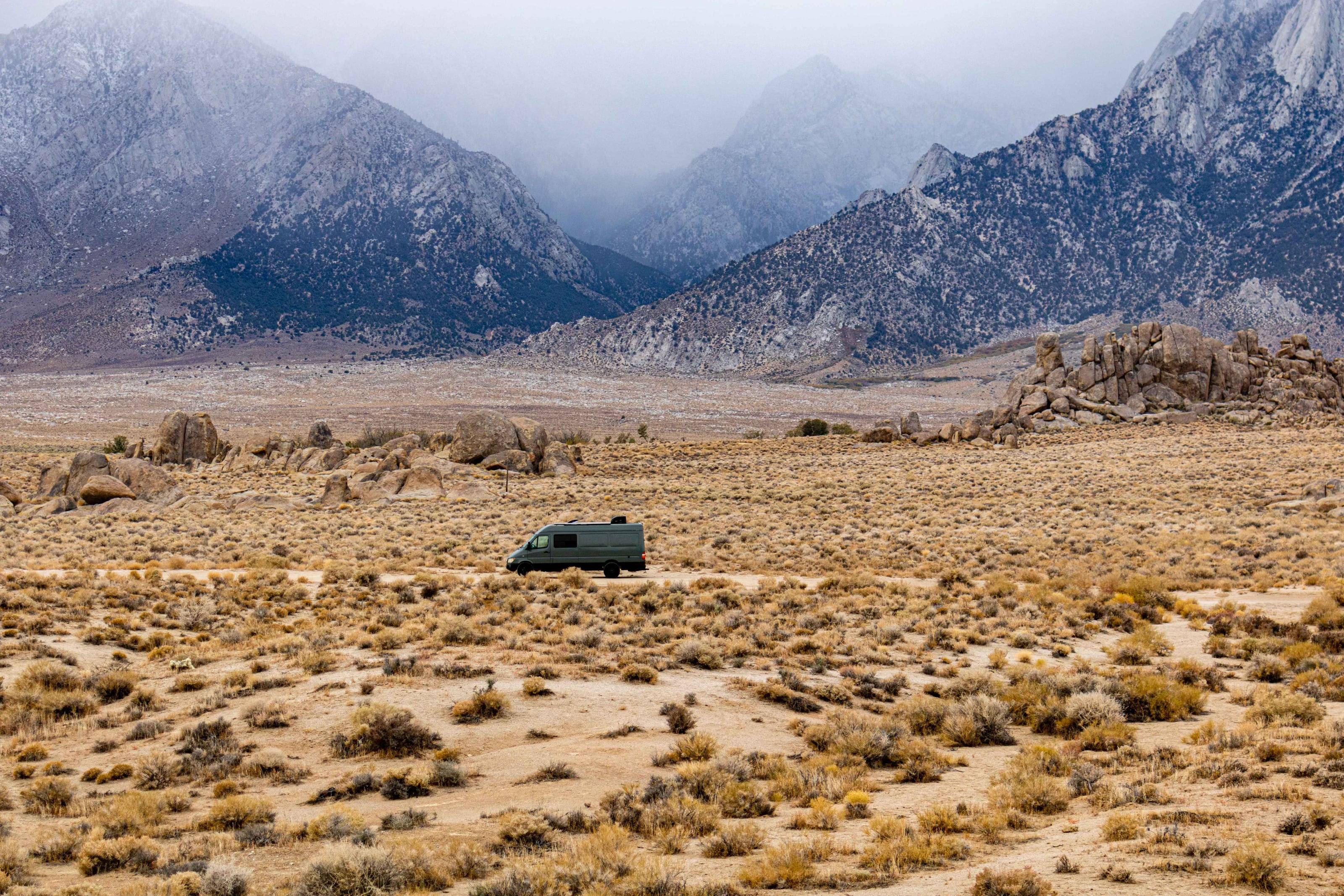
Cold changes every system on the vehicle and every mistake you can make. The battery has less to give, the fuel can turn to wax, the road is a different surface every hour, and being stuck stops being an inconvenience.
This guide covers what the states actually require of your tires, what cold does to diesel and batteries, how to be stuck safely, and the two things that kill people in winter: carbon monoxide and the snow above you. It is an introduction, and winter driving and avalanche skills are taught hands-on for good reason.
What the law requires of your tires
Traction and chain requirements are set state by state and turned on by signage when conditions warrant, so the only rule that applies everywhere is to read the signs and the state's own travel page. Two examples show the shape of it.
Colorado's Department of Transportation implements a Passenger Vehicle Traction law during storms. It requires either an all-wheel or four-wheel drive vehicle with mud and snow, winter or all-weather rated tires and at least 3/16 inch of tread, or chains or an approved alternative traction device. In a severe storm it goes further to the passenger vehicle chain law, which the department calls "the final safety measure before the highway is closed", and then every vehicle must have chains or an approved device.
California runs three numbered levels. R-1 requires chains on all vehicles except passenger vehicles and light trucks under 6,000 pounds with snow tires on at least two drive wheels. R-2 requires chains except on four-wheel or all-wheel drive vehicles with snow-tread tires on all four, which must still carry chains in the control area. R-3 requires chains on everything, no exceptions, and Caltrans notes a highway is often closed before R-3 is imposed. When chains are required the speed limit is 25 or 30 miles an hour, you must pull completely off the road to the right to fit them, and Caltrans advises checking your own vehicle maker's guidance on chain use first.
What this means in practice: carry chains that fit your vehicle and have fitted them once in daylight, and know how to identify a snow-tread tire, which Caltrans describes as having MS, M/S, M+S or the words MUD AND SNOW stamped into the sidewall.
Do not skipThese are two states as examples, not the national rule. Check the transportation department of every state you will cross, and expect to be turned back if your vehicle does not comply.
Source 1
Cold starts, batteries and diesel
Cold takes power out of a battery at the moment the engine needs more of it: NHTSA notes that in cold weather both petrol and diesel engines take more battery power to start, and the range of electric and hybrid vehicles falls. A battery check before winter is the single highest-value item on the list, along with the charging system and belts.
Diesel has its own problem, and it is worth understanding rather than fearing. Diesel contains paraffin waxes that solidify as the temperature falls. Chevron's technical review describes the two points: the cloud point, where wax begins to precipitate and the fuel goes cloudy, and the pour point or gel point, where the fuel becomes so thick it will not flow. Wax "may plug the fuel filter or completely gel the fuel, making it impossible for the fuel system to deliver fuel to the engine".
Refineries handle this by blending with a lower-wax fuel such as No. 1-D or kerosene, or by treating it with an operability additive, which is why the winter fuel sold in a cold region works there. The catch is the trip that starts warm: summer fuel used in cold weather can wax and plug a filter. If you add an additive yourself, Chevron notes it must go in before any wax has formed, while the fuel is above its cloud point, and that no additive performs equally in all fuels. Vehicles built for cold work have heated tanks, insulated lines and heated filters. And always check what your engine maker says your engine can run on.
Tire pressure falls with temperature too, so check it cold, at the maker's figure from the door placard, once the vehicle has stood.
Source 4
Driving it
NHTSA's winter advice is short: slow down, because it is harder to control or stop on a slick surface, and increase your following distance enough to have plenty of time to stop. Do not crowd a snow plough or travel alongside it.
The Weather Service adds the two that people forget. Clear the vehicle completely of snow and ice before starting, and remember that a road that merely looks wet may be ice.
If you begin to skid, ease off the accelerator and steer where you want the front of the vehicle to go. With antilock brakes apply firm, steady pressure and do not pump them; without them, you may need to pump if the wheels lock. Momentum is your friend on a climb and your enemy everywhere else.
Source 3
Being stuck, safely
The advice from both the Weather Service and NHTSA is the same and it is counterintuitive: stay in the vehicle. In wind-driven snow you will become disoriented quickly, and the vehicle is shelter and a signal.
Run the engine about ten minutes each hour for heat. While it runs, open a window a little for fresh air, and clear snow from the exhaust pipe. Make yourself visible: dome light on at night while the engine runs, a bright cloth, red if you have one, tied to the antenna or the door, and the hood raised once the snow stops.
Do not overexert yourself. Shovelling heavy snow or pushing the vehicle can bring on a heart attack, and sweating leads to a chill and then hypothermia. If you need water, melt snow rather than eating it, because eating snow lowers your body temperature.
Do not skipCarbon monoxide is what kills people who do everything else right. Never run the engine for long periods with the windows up or in an enclosed space, and clear the exhaust pipe of snow every single time before you start it.
Source 5
Hypothermia and frostbite
Hypothermia does not need extreme cold. The CDC notes it can occur even above 40 degrees Fahrenheit if someone is chilled by rain, sweat or cold water. Its danger is that it attacks judgment: low body temperature "affects the brain, making the victim unable to think clearly or move well", so a person may not know it is happening.
Watch other people for the signs rather than waiting to notice them in yourself: shivering, exhaustion, confusion, fumbling hands, memory loss, slurred speech, drowsiness. The CDC calls it a medical emergency, and says that below 95 degrees Fahrenheit you should get medical attention immediately. Meanwhile get the person into shelter, remove wet clothing, and warm the core, chest, neck, head and groin, with skin-to-skin contact under dry blankets. Warm drinks help; alcohol does not, and never give a drink to someone unconscious.
Frostbite takes the extremities: nose, ears, cheeks, chin, fingers, toes. Redness or pain is the warning to get out of the cold; the signs of frostbite itself are white or greyish-yellow skin, skin that feels unusually firm or waxy, and numbness, and the person often does not know because the part is numb. Do not rub the area or rub snow on it, do not walk on frostbitten feet unless you must, and warm it in warm, not hot, water. Never use a heating pad, a heat lamp, a stove or a radiator, because numb skin burns easily.
Source 6
Avalanche terrain
Winter roads cross avalanche paths, and a vehicle is no protection. Avalanche.org, a partnership of the American Avalanche Association and the Forest Service National Avalanche Center, is where the forecasts live: most centres publish a daily forecast for a specific area covering 24 to 48 hours, with the danger rating, the avalanche problems, travel advice and the weather.
Two facts shape how you read a map. Most slab avalanches start on slopes between 30 and 50 degrees, and avalanches starting below 30 degrees are rare. But the slope you are on is only half the question: the ground above you can release naturally, or be released by someone else, and overhead hazards are sometimes hidden by cloud or terrain.
The danger scale has five levels, Low to Extreme, usually given for three elevation bands, and the danger increases exponentially between levels rather than evenly. Avalanche.org's own summary of what to do is three things: get the forecast, get the gear, get the training. Its education pages list course providers, and it notes that avalanches kill 25 to 30 people in the United States each winter.
Do not skipReading this is not avalanche training. If your winter travel takes you under or across avalanche terrain, take a course from a listed provider, carry a transceiver, probe and shovel, and travel with people who have done the same.
Source 8
Sleeping out in the cold
The carbon monoxide rule is absolute and it applies to sleeping as much as to cooking: never use a portable heater, lantern or stove inside a tent, a camper or a vehicle. The Consumer Product Safety Commission says people die every year doing exactly that, and the risk rises at altitude. Only a sealed heater with its exhaust outside the living space belongs in a vehicle, and a carbon monoxide alarm belongs anywhere people sleep.
Everything else is ventilation and dryness. Condensation is worst in the cold, so keep a vent open at each end even when it seems mad. Change out of anything damp before you sleep, because wet clothing is how hypothermia starts at temperatures that feel survivable.
Source 7
Where to learn it
Winter driving, recovery in snow and avalanche awareness are taught by instructors, and the directory lists training providers by state. Avalanche.org lists avalanche course providers near you.
Tire shops and mechanics are worth a visit before the season: a battery and charging check, the right tires for where you are going, and chains that you have fitted once in the daylight rather than for the first time on a hill in the dark.
Questions people ask
Do I need chains if I have four-wheel drive?
Often yes, and sometimes you must carry them even when you are exempt from fitting them. Under California R-2, four-wheel drive vehicles with snow-tread tires on all four wheels are exempt but must still carry traction devices; under R-3 there are no exemptions. Colorado requires either qualifying tires with 3/16 inch of tread or chains, and in a severe storm chains for everyone.
What is a snow-tread tire?
Caltrans defines it as a tire with MS, M/S, M+S or the words MUD AND SNOW stamped into the sidewall. Colorado accepts the mountain-snowflake icon, M+S or an all-weather rating, with at least 3/16 inch of tread.
Why does diesel gel, and what do I do about it?
Diesel contains paraffin waxes that solidify as it cools; wax can plug the filter or stop the fuel flowing altogether. Winter fuel sold in cold regions is blended or additised for this. If you treat fuel yourself it must be done before any wax forms, while the fuel is above its cloud point.
What should I do if I am stuck in a snowstorm?
Stay in the vehicle. Run the engine about ten minutes an hour for heat, with a window cracked and the exhaust pipe cleared of snow every time. Make yourself visible, do not overexert yourself, and melt snow rather than eating it.
How do I know if a slope above the road is dangerous?
Read the local avalanche centre's forecast at avalanche.org before you go. Most slab avalanches start on slopes of 30 to 50 degrees, and terrain above you matters as much as the ground you are on. Take a course before travelling in avalanche terrain.