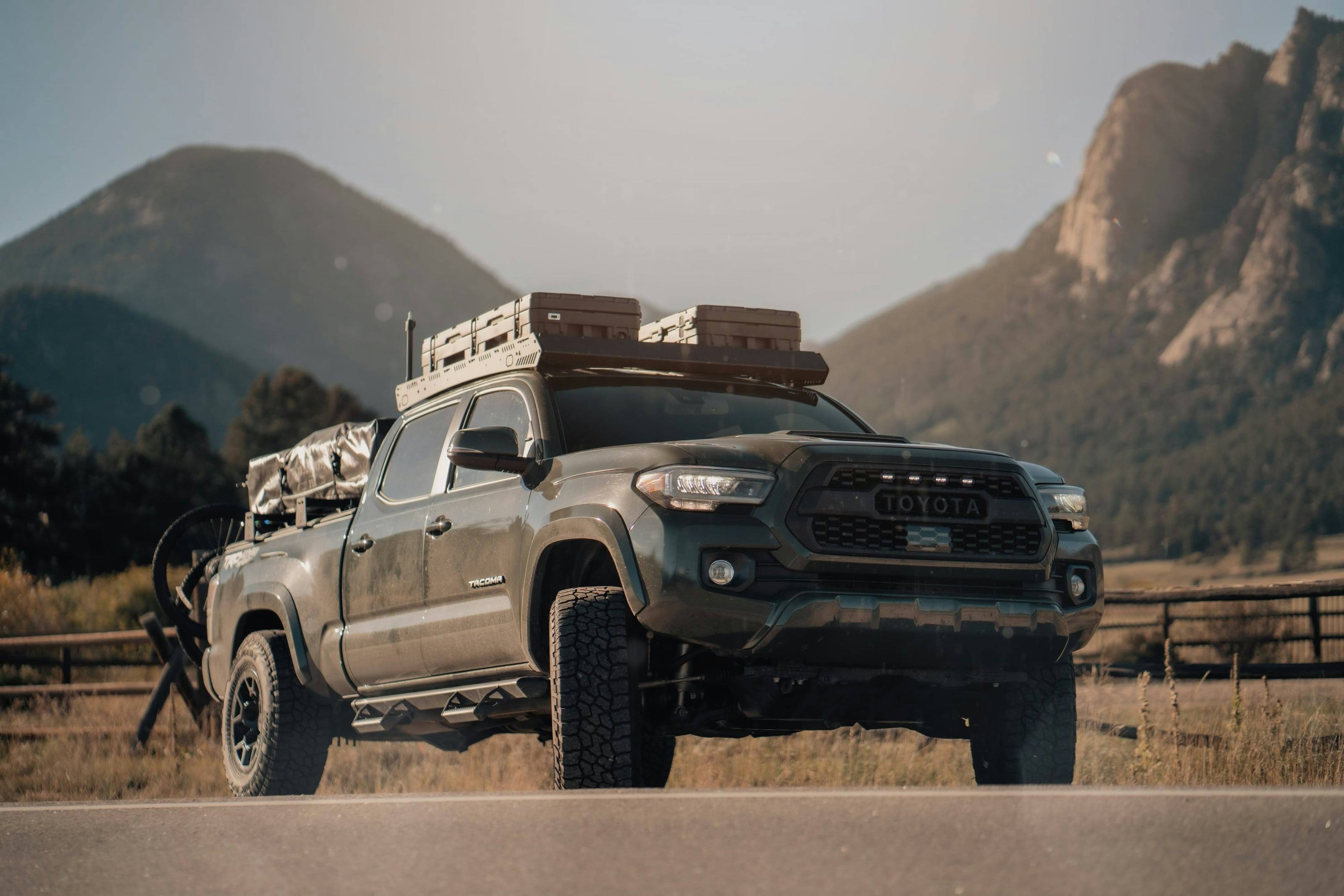
A midsize pickup is the most adaptable overland platform sold in America, because the bed takes the weight and the mess while the cab stays clean and quiet. The Tacoma has been the default version of that idea in the United States for three decades.
It is also the platform where payload arithmetic matters most, because two different official numbers describe it and they do not agree. This guide sets out what Toyota publishes for the current truck, explains which figure governs, and puts the upgrades in the order that wastes the least money.
What the Tacoma does well for travel
The bed is the argument. Fuel cans, wet recovery gear, firewood and a shovel live outside the cabin, and a camper, a canopy or a flat rack can change what the truck is in an afternoon. Toyota fits a deck rail system with four adjustable tie-down cleats and fixed bed tie-down points as standard, which means a load can be secured without drilling anything.
Underneath, the four-wheel drive grades use a part-time system with an electronically controlled two-speed transfer case, and the Limited i-FORCE MAX uses full-time four-wheel drive with an electronic locking center differential. The TRD Off-Road grades, Trailhunter and TRD Pro add an electronically controlled locking rear differential with Multi-Terrain Select, Crawl Control and Downhill Assist Control. Trailhunter and TRD Pro also get the Stabilizer Disconnect Mechanism and a factory lift of one inch at the front and half an inch at the rear.
Most Double Cab grades use a coil-sprung multi-link rear suspension, while the XtraCab and SR configurations keep leaf springs, which is worth knowing before you plan a heavy rear build.
Two factory details change camp life. Every i-FORCE MAX hybrid grade carries a 2400-watt bed-mounted alternating current supply, where the gas grades get a 400-watt supply, standard on Limited and available in option packages elsewhere. Trailhunter adds an integrated high-output air compressor, a high-mount air intake, a steel skid plate and protectors, frame-mounted rock rails and prewired auxiliary switches.
Source 1
What it asks of you: two payload numbers, and the lower one wins
Toyota publishes maximum payload figures from 1,230 lb. to 1,705 lb. depending on configuration. Those are real, and they are not the number that governs your build.
The owner’s manual publishes vehicle capacity weight, occupants and luggage combined, and it is several hundred pounds lower. A four-wheel-drive Double Cab is rated at 1,200 lb., or 1,270 lb. with the TRD Sport Package. A four-wheel-drive XtraCab is rated at 880 lb. Two-wheel-drive Double Cab models are rated at 1,200 lb., and two-wheel-drive XtraCab models at 1,060 lb. or 1,100 lb. depending on package.
The figure on the tire and loading information label inside your own door is the one to build to. Subtract the people first. A pair of adults takes a meaningful bite out of an 880 lb. allowance before a single jerry can is filled, which is why a camper on an XtraCab is a harder problem than it looks.
Trailer tongue weight comes out of the same allowance, up to the 640 lb. or 650 lb. maximum Toyota lists. A trailer does not let you carry more; it lets you tow more while carrying less.
Source 2
The bed, the deck rails and what they will hold
The deck rail system is the reason bed builds on this truck are quick, and it has published limits. To use the rails you fit accessories made for them, and Toyota sets a maximum of three accessory locations per rail on the short deck and four on the long deck, spread evenly along the rail.
The load limit per rail is 440 lb. of total tensile load. That figure covers tie-down cleats, storage boxes and anything else clamped to the rail, and it is easy to exceed with a heavy rack and a tent above it.
Toyota also tells you to make sure rail accessories such as storage boxes are securely attached, so that luggage cannot slide forward under braking. A bed load that shifts on a washboard road can arrive at the cab.
Do not skipNever allow anyone to ride in the rear deck. Toyota states plainly that it is not designed for passengers, and that people who ride there are far more likely to suffer death or serious injury in sudden braking, sudden swerving or a crash.
Source 3
Where the Tacoma came from
Toyota introduced the Tacoma on 10 February 1995 at the Chicago Auto Show, and described it then as its sixth-generation compact pickup truck. The name was new; the truck behind it was not.
The first Tacomas were all built at New United Motor Manufacturing in Fremont, California. The engine lineup was a 2.4-liter four in two-wheel-drive models, a 2.7-liter four in four-wheel-drive models, and a 3.4-liter V6 available on both, which had been introduced the previous autumn in the larger T100 pickup.
Three decades later the shape of the argument is the same. A midsize Toyota pickup earns its place by being repairable, widely supported and easy to adapt, which is why so much of the aftermarket for overland travel is built around it.
Source 4
Weight decides everything, so weigh the truck
Gross vehicle weight rating runs from 5,605 lb. to 6,835 lb. across the range, and base curb weight from 4,145 lb. to 5,410 lb. The heaviest configurations are the hybrids, and they carry the highest ratings, so the two move together rather than cancelling out.
Weigh the truck empty, then weigh it loaded the way you travel, with water and fuel aboard, the camper or canopy fitted and passengers in their seats. Public scales at a truck stop or a landfill give axle weights for a small fee.
Take both readings that matter: total weight against the gross vehicle weight rating, and each axle against its own rating. Pickups fail the rear axle first, because a camper, a drawer system, a spare tire and a full water tank all sit behind the cab. A truck that is legal on the total and overloaded at the rear handles badly, brakes worse and eats tires.
With a real number in hand, spring rates, tire load index and brake expectations all become straightforward decisions rather than guesses.
Source 1
The upgrades that matter, in the order most owners need them
Work down this list rather than across it, and weigh the truck again after anything heavy goes on.
The order that wastes the least money
- 01Tires, in the size the truck was designed around, with a load index that suits your measured rear axle weight. Most grades carry a full-size spare, so keep it matched.
- 02A way to air down and air back up. On grades without the factory compressor, this is the first accessory that earns its space.
- 03Suspension matched to the finished weight, after the truck is weighed. A rear spring rate chosen for a camper you have not bought yet will ride badly for a year.
- 04Protection where your grade lacks it. TRD Off-Road grades have a composite front skid plate with transfer case and fuel tank protection, Trailhunter adds steel; rockers and the rear differential are the usual gaps.
- 05Recovery points, and knowing which ones you have. Toyota fits a passenger-side front recovery point on many grades, driver and passenger front points on the TRD Off-Road grades, and front and rear dual points on Trailhunter and TRD Pro.
- 06Bed storage and power last. The factory deck rails carry a published limit, hybrid grades already supply 2400 watts at the bed, and every pound of drawer, rack or tent comes out of the capacity weight on the door label.
Source 1
Maintenance before a long trip
Toyota asks for scheduled maintenance every 5,000 miles or six months, whichever comes first, then adds services for special operating conditions.
Driving on dirt or dusty roads brings inspection of ball joints and dust covers, drive shaft boots, the engine air filter and steering linkage and boots at every 5,000-mile interval, along with torquing of the propeller shaft bolts and the chassis and body fasteners. Towing a trailer, using a car-top carrier or running heavy vehicle loading adds front and rear differential oil, transfer case oil and transmission fluid service. A truck driven mainly on dirt or dusty roads takes engine oil and filter every 5,000 miles or six months instead of the longer default interval.
There is also a daily list for off-road use. When you drive off-road through deep sand, mud or water, Toyota asks you to check, every day, the ball joints and dust covers, brake lines and hoses, brake linings, drums, pads and discs, differential oil, drive shaft boots, engine air filter, chassis and body fasteners, steering linkage and boots, transfer case oil and transmission fluid, and to torque the propeller shaft bolts.
Before a long trip, run that list as a pre-departure inspection and add what a loaded truck punishes: pad thickness, coolant condition, spare tire pressure, and the torque on anything bolted to the frame since the last trip.
Source 5
Finding a specialist, and checking for recalls
For a pickup, the most valuable shop is the one that will weigh the truck before selling you springs. A 4x4 shop or an overland builder handles suspension, lockers, gearing and whole builds. A fabricator makes bumpers, sliders, bed racks and flat decks, and is the right trade for anything that bolts to the frame. An overland mechanic keeps the drivetrain and cooling system honest between trips, and an overland outfitter handles the bolt-on equipment.
Recalls are the one form of known problem worth checking yourself. The federal safety regulator publishes a lookup by vehicle identification number that shows unrepaired recalls for a specific vehicle. It states that the search will not show a recall already repaired, some recently announced recalls for which not all vehicle identification numbers have been identified, or safety recalls more than 15 years old. Check the number on your own truck rather than a summary for the model.
Source 6
Questions people ask
Which payload number should I trust?
The lower one, on the tire and loading information label inside the door. The specification tables give a maximum payload derived from weight ratings, while the owner’s manual gives vehicle capacity weight for occupants and luggage combined. Build to the label, and subtract the people first.
Can a Tacoma carry a camper?
A light one, on a Double Cab, with the weights checked first. Work from the capacity weight on the door label, subtract the camper dry weight, then subtract water, propane, gear and passengers. Many popular campers use the entire allowance on their own.
Short bed or long bed?
The long bed carries more, sleeps a tall person flat and tows more steadily. The short bed turns tighter and is easier to place on a narrow trail. Both take the same deck rail accessories, though the long deck allows an extra accessory location per rail.
Hybrid or the turbo four?
The hybrid brings more torque and a much larger bed power supply, and it weighs several hundred pounds more, which comes out of your load. The gas engine is lighter and leaves more allowance for gear. Pick according to what you intend to carry and run.
Do I need the off-road grade?
Not for most travel. The off-road grades bring a locking rear differential, terrain modes and better clearance, and Trailhunter adds protection, a compressor and auxiliary switches from the factory. If you would fit all of that anyway, buying it built is usually tidier.