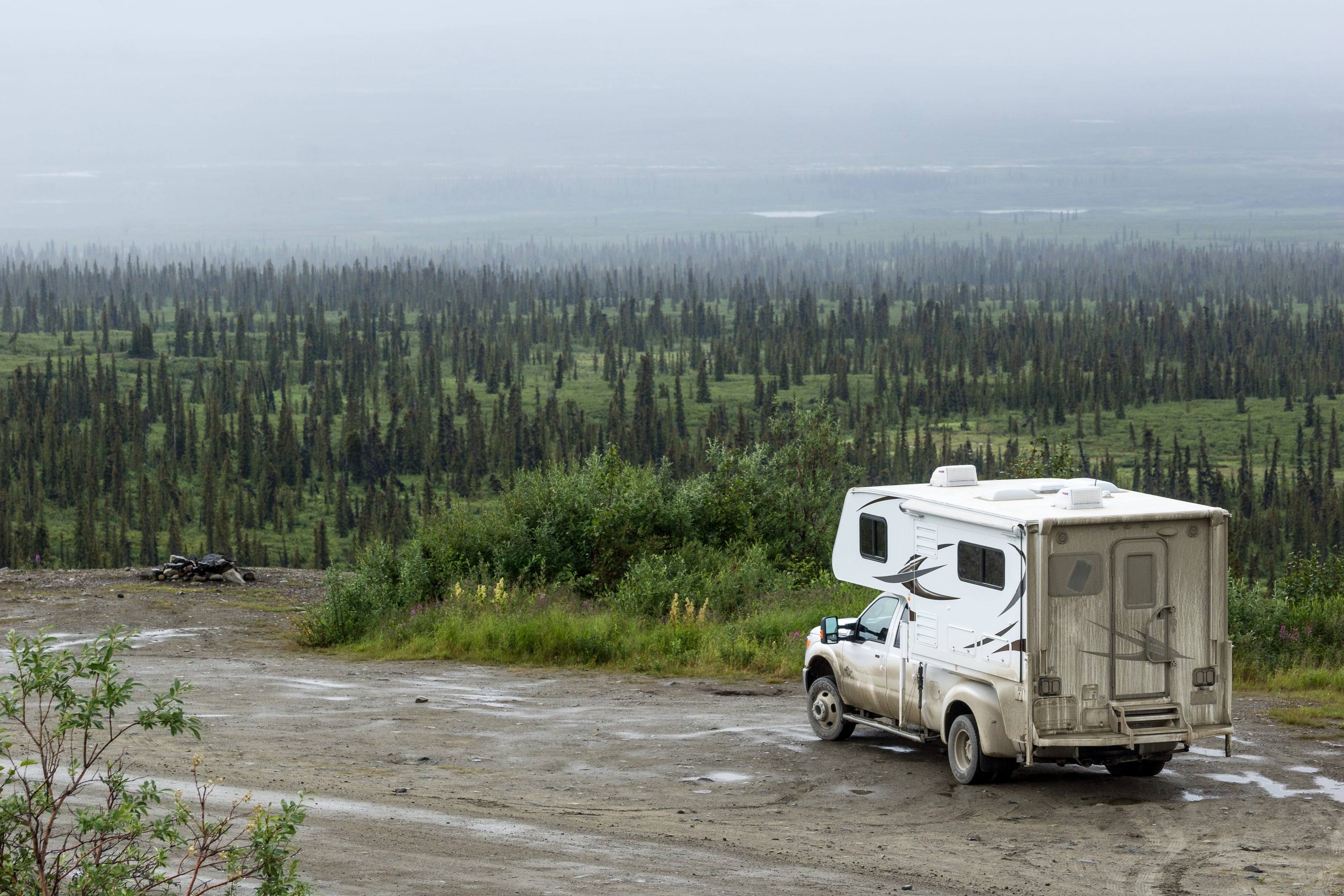
A truck camper is the only way to have a hard-sided home and still take the camper off and drive an ordinary truck on Monday. Nothing else in overlanding gives you that, which is why the format survives decades after the magazines wrote it off.
It is also the format where mismatches are most common and most dangerous. A camper that is too heavy for the truck does not announce itself. It steers a little lazily, wears the rear tires, and then behaves very badly once. NHTSA wrote a rule specifically about this, and its whole purpose is to help you avoid overloading and improper load placement in truck-camper combinations. This guide is built around that rule.
What a truck camper is, and who it suits
NHTSA defines a slide-in camper as a camper having a roof, floor and sides, designed to be mounted on and removable from the cargo area of a truck by the user. That definition is the whole category: a box that lives in a pickup bed and comes out again.
Within it there are two families. Hard-sided campers give you a fixed roof, insulation, and usually a wet bath, at the cost of height, weight and wind. Pop-up campers drop to roughly cab height for travel, which lowers the centre of gravity and the fuel bill and makes brushy roads survivable, at the cost of insulation and a fabric wall you have to look after.
The format suits people who already own or want a capable pickup, who value being able to unload and drive the truck alone, and who travel roads where a trailer would be miserable to reverse. It suits nobody who wants to leave camp set up while they go exploring, which is the one thing a trailer does better.
Source 1
The numbers that decide the choice
Four numbers decide whether a combination works, and all of them live on labels rather than in brochures. Gross vehicle weight rating is the value the manufacturer specifies as the loaded weight of a single vehicle. Gross axle weight rating is the load-carrying capacity of a single axle system, measured at the tire-ground interfaces. Curb weight is the truck with standard equipment and full fluids, and unloaded vehicle weight is the same idea without removable accessories.
The one that matters most for a camper has its own definition. Cargo weight rating is the cargo-carrying capacity the manufacturer specifies for the truck, exclusive of the weight of occupants, which is computed separately at 150 lb per designated seating position. That word exclusive is where people go wrong: the cargo weight rating is not a budget you can spend on people as well as on a camper.
The fifth number is not on the truck at all. Every slide-in camper has to carry a label, on an exterior rear surface, stating the camper weight with standard equipment, a full fresh water tank, full bottled gas and the refrigerator or ice, and the manufacturer has to list in the owner’s manual the weight of every additional or optional item heavier than 20 lb. That label figure, plus the options actually fitted, is the number you match to the truck.
Source 1
The calculation, in the order NHTSA sets it out
The rule spells out the arithmetic that camper manuals must contain, and it is worth doing before you shop rather than after. To estimate the total cargo load that will be placed on a truck, add the weight of all passengers in the camper, the weight of supplies, tools and all other cargo, the weight of installed additional or optional camper equipment, and the manufacturer’s camper weight figure. Then select a truck whose cargo weight rating is equal to or greater than that total.
There is a second half to the match that people skip: the centre of gravity. Truck manufacturers publish a recommended longitudinal centre of gravity zone, and camper manufacturers publish where the loaded camper’s centre of gravity sits, to within two inches. The camper’s has to fall inside the truck’s zone. A camper that is light enough but sits too far back makes the front axle light, and that is a steering and braking problem, not a comfort one.
Then weigh it. NHTSA’s instruction is to drive the loaded truck-camper to a scale and weigh the front and rear wheels separately: no axle over its rating, and the total no more than the gross vehicle weight rating. If the ratings are exceeded, move or remove items until they are not.
Load it the way the rule says
- 01Store heavy gear first, keeping it on or close to the camper floor.
- 02Place heavy things far enough forward to keep the loaded centre of gravity inside the truck’s zone.
- 03Store only light objects on high shelves.
- 04Distribute weight to get even side-to-side balance, then secure everything against shifting.
- 05Travel with water tanks either full or empty rather than half, and remember water is cargo.
Source 1
What the truck maker publishes, and where to find it
Truck manufacturers publish the other half of the match in their annual towing and payload guides, and the definitions there line up with the federal ones. Payload is the combined maximum allowable weight of cargo and passengers the vehicle is designed to carry: the gross vehicle weight rating minus the base curb weight. Base curb weight is the vehicle with a full tank of fuel and standard equipment, and does not include passengers, cargo or optional equipment.
For campers these guides publish a maximum cargo weight chart by model, wheelbase and engine, and they are explicit about the assumptions: the rating assumes a base vehicle with the required camper option content and a 150 lb passenger at every seating position, and must be further reduced by the weight of a transmission upgrade and any other options. Every option you ordered comes out of the number in the chart.
The centre of gravity data is not in the guide. One manufacturer states that camper centre-of-gravity information appears on the Consumer Information Sheet in the glovebox, calculated for each individual truck based on its options, and that if a vehicle does not qualify for camper use the sheet says so and shows no data. That sheet is worth finding before a purchase, on a new truck or a used one.
Source 4
Tires and axles: the limit nobody reads
A camper puts its weight on the rear axle, and the rear axle puts it on two tires. Federal standards require that the sum of the maximum load ratings of the tires fitted to an axle be not less than the gross axle weight rating of that axle. That is the rule that quietly disqualifies a lot of good-looking wheel and tire upgrades.
There is a trap in it for anyone moving from a passenger-style tire to a light-truck tire or back. When passenger car tires are installed on a truck or multipurpose passenger vehicle, each tire’s load rating is reduced by dividing it by 1.10 before the axle comparison is made. A tire that carries a given load on a car carries about nine percent less, on paper, under a truck.
Pressure is the other half. The vehicle placard on the door pillar carries the manufacturer’s recommended cold inflation pressures and the statement of how much combined occupant and cargo weight the vehicle may carry. Those pressures are set for the load; a truck carrying a camper is at the top of its range, not the bottom, and the pressures should be read and set cold.
Source 2
Living with one on rough roads
A loaded camper changes the truck into a tall, heavy, rear-biased vehicle. The practical consequences are predictable: slower speeds on corrugations, more care on side slopes, wider lines through ruts, and an unwillingness to commit to anything you have not walked. A pop-up lowers the worst of it, which is why the format is popular where trees and wind are involved.
Tires are the maintenance item that matters most, and the failure mode is age as much as wear. NHTSA is explicit that the correct pressure is the one on the vehicle placard, not the maximum moulded into the sidewall, and that it should be set cold. On aging, it names recreational vehicles as a category at risk because they are driven seasonally, and says some vehicle and tire manufacturers recommend replacing tires that are six to 10 years old regardless of treadwear.
Check the spare. It is the tire that never gets rotated, never gets inspected and is expected to work on the worst day of the trip.
Source 5
Maintenance and inspection
Truck campers fail at the interfaces. The tie-downs and turnbuckles carry the camper through every impact the suspension does not absorb, so they want checking at the start of a trip and after any hard section, along with the mounting points they bolt to on the truck. Corrugations undo fasteners that torque held fine on pavement.
The second failure point is water, from outside and from inside. Walk the roof, the seams and every penetration after rough roads, before the leak becomes a soft floor. Inside, check the water system, the propane connections and the twelve-volt wiring for chafe where the box flexes against the bed.
The third is the truck itself. Brakes, rear suspension components and wheel bearings all work harder under a camper than they were specified to, and the service interval that matters is the manufacturer’s severe-duty one rather than the normal one.
Finding a dealer, a builder or a shop
Buying a camper and fitting a camper are different jobs, and often different businesses. A dealer will sell you the box; a builder or fabricator will sort out the tie-down system, a bed platform where one is needed, and the wiring and plumbing connections; and an RV service centre will look after the living side afterwards.
Our directory lists expedition vehicle dealers, overland builders, fabricators, RV and van service centers and overland mechanics by state, along with suspension and tire specialists for the truck underneath. When you call, ask what the shop weighs combinations on, and whether it will give you a written axle-by-axle weight ticket. A shop that answers that question well is usually good at everything else too.
Questions people ask
What is wet weight, and why does it differ from the brochure?
The label a camper manufacturer must fix to the camper states its weight with standard equipment, a full fresh water tank, full bottled gas and the refrigerator or ice. Brochure weights are often the dry figure without any of that, and without options. Match the labelled figure plus the options actually fitted, not the brochure.
Does the truck’s payload include passengers?
It depends which number you are reading. A truck maker’s payload figure is the gross vehicle weight rating minus the base curb weight, so people come out of it. The cargo weight rating used for campers is defined by NHTSA as exclusive of occupants, computed separately per designated seating position. Either way, everybody in the cab and in the camper has to be counted somewhere.
Can I add airbags or heavier springs to carry more?
They can improve how the truck sits and rides, but they do not change the gross vehicle weight rating, the axle ratings or the tire load ratings, which are the limits that matter legally and physically. Level the truck with them if you like. Do not use them to justify a heavier camper.
Hard side or pop-up?
A pop-up lowers the centre of gravity, the frontal area and usually the weight, which makes rough roads and wind easier and keeps you under more branches. A hard side gives insulation, quicker stops and usually a better bathroom. Most people who drive rougher roads end up with a pop-up, and most people who camp in the cold end up with a hard side.
Do I need a special licence for a truck and camper?
Usually not, because most truck-camper combinations stay well under the weight thresholds that trigger a different licence class. If you are also towing, check the combined rating against your own state’s rules, since states set their own non-commercial classes.