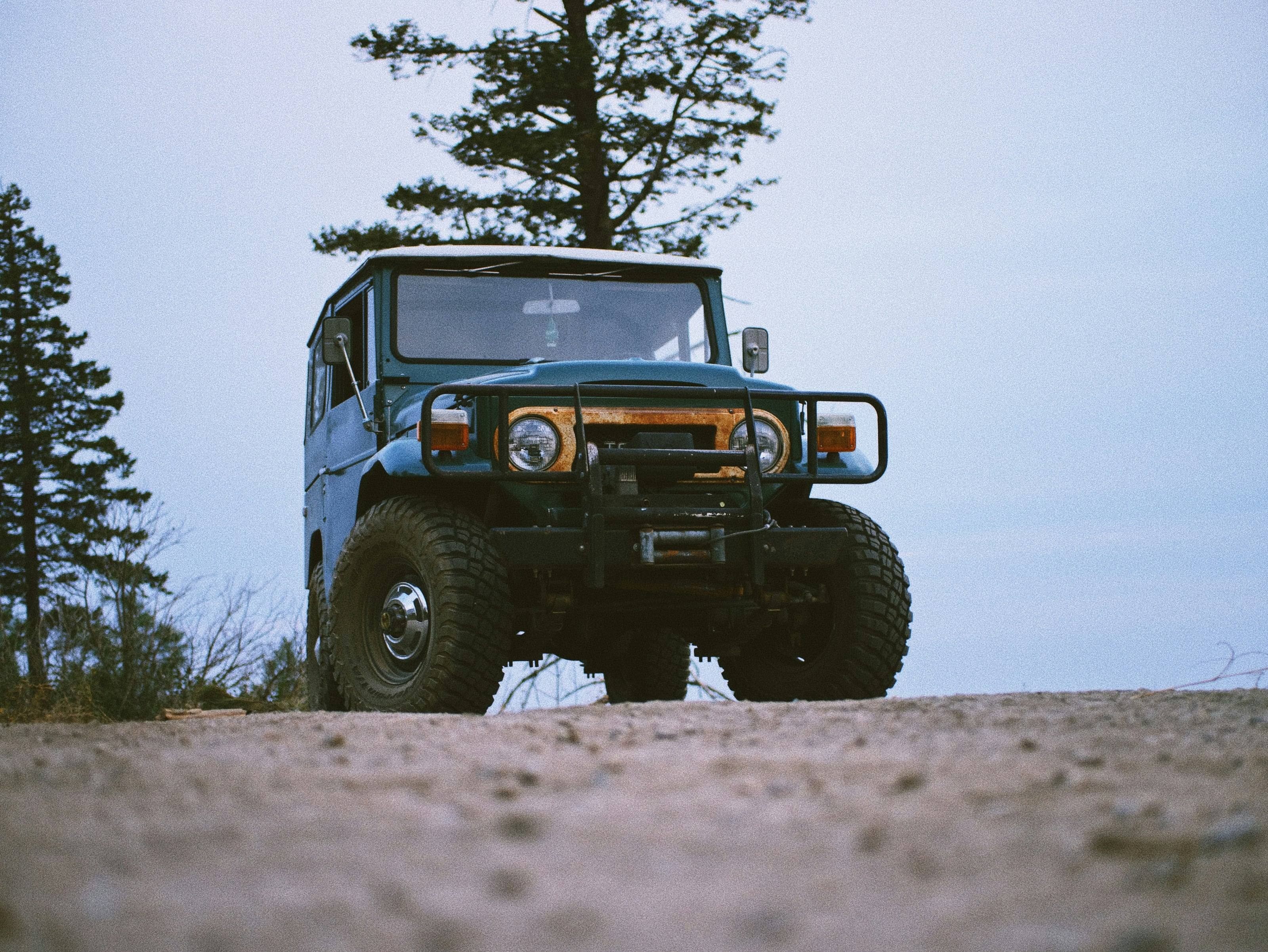
The Land Cruiser sold in the United States today is the 250 series, a body-on-frame wagon on the same truck platform as the Tacoma, 4Runner, Tundra and Sequoia. Toyota describes the model as a return to the origin of the vehicle: simple, sturdy, built for people who need it to work.
For overland travel that matters less than one number on a label inside the door. This guide gathers the figures Toyota publishes for the current United States model, explains which of them limits a build, and sets out the order most owners should spend money in.
What the 250 series does well for travel
The case for this truck is not one specification. It is a full-time four-wheel drive system with a locking center differential, a locking rear differential, a low range, and a chassis built around long service life.
Toyota lists full-time four-wheel drive with active traction control and a Torsen limited-slip center differential with a locking feature as standard on both United States grades, along with electronically controlled locking rear and center differentials, Crawl Control and Downhill Assist Control. The Land Cruiser grade adds Multi-Terrain Select and the Stabilizer Disconnect Mechanism, which uncouples the front stabilizer bar so the suspension articulates further at low speed.
The details that matter most to a traveler are duller. A full-size spare on an alloy wheel is mounted under the body, frame-mounted tow hooks are fitted front and rear, a front skid plate covers the engine, transmission and transfer case, and a hitch receiver with four-pin and seven-pin connectors and a 2400-watt inverter are standard. Much of what people add to other platforms is already bolted to this one.
Source 1
What it asks of you: payload, and what goes on the roof
Every other figure is easier to live with than payload. Toyota lists a maximum of 1,365 lb. on the 1958 grade and 1,280 lb. on the Land Cruiser grade. That is the entire allowance for people, water, fuel cans, food, recovery gear, a fridge, a tent, a rear bumper, sliders, drawers and the dog.
The owner’s manual sets out how to work with it. Cargo capacity depends on the total weight of the occupants, so the manual tells you to find the combined weight statement on the vehicle placard, subtract the people, and treat the remainder as your cargo allowance. Its worked example uses passengers of 150 lb. each, a generous figure for most adults with boots on.
The roof has a limit of its own: no more than 165 lb. of cargo on the roof luggage carrier. That weight counts against the same total while doing the most harm to stability, and a hard-shell tent and its rack can approach the figure before anyone climbs in.
If you tow, the manual is equally direct. Load from a trailer transfers to the vehicle and reduces the cargo and luggage capacity you have left.
Do not skipToyota’s warning is short. Do not exceed the maximum axle weight rating or the total vehicle weight rating, and do not load unevenly even when you are under the total, because improper loading can cause deterioration of steering or braking control.
Source 2
Weight decides everything, so weigh the truck
The owner’s manual gives a second, lower number that governs in practice. Vehicle capacity weight for five-passenger models, occupants and luggage combined, is 1,100 lb. Two adults in the front seats take roughly 300 lb. of that before a single item is loaded.
The same table sets trailer weight rating at 6,000 lb. with trailer brakes and 1,650 lb. without them. Tongue weight then lands on the rear axle and comes out of the cargo allowance, not in addition to it.
So weigh the vehicle, empty and then loaded for a real trip, with water and fuel aboard and passengers in their seats. Public scales at a truck stop or a landfill give axle weights for a small fee. Take two readings: total weight against the gross vehicle weight rating, and each axle against its own rating. Builds that pass the first and fail the second are common, because heavy things migrate behind the rear axle.
Once the finished weight is known, the rest of the build gets easier to specify. Springs can be matched to a load that exists, tires chosen by load index against measured axle weights, brakes and cooling judged against the truck you actually drive.
Source 3
The line that reached America
The wagon most American buyers picture starts with the FJ55, introduced in 1967 with a 3.9-liter six-cylinder engine, a two-speed transfer case and a three-speed manual gearbox. The 60 series replaced it in August 1980 with a 4.2-liter gasoline engine and a new body.
The 80 series followed in October 1989, and it changed the character of the vehicle: the leaf springs of the rigid axle suspension were replaced with coil springs, higher grades adopted full-time four-wheel drive with a center differential, and the body grew to suit overseas markets including North America.
The 100 series arrived in January 1998 with a 4,663 cc V8 and full-time four-wheel drive. The 200 series launched in September 2007, and Toyota notes that the North American version was fitted with a 5.7-liter gasoline engine.
Source 6
The 250 series, and why it came back
Toyota dates the line to the Toyota BJ, launched on 1 August 1951, which became the first vehicle to climb to the sixth station of Mount Fuji. Until recently the range was divided in three: a station wagon that carried the newest technology and became the flagship, currently the 300 series; a heavy-duty model, the 70 series; and a light-duty model sold as the Prado.
The light-duty line had drifted upmarket. In developing the 250 series Toyota set out to return it to what it calls the origin of the Land Cruiser: a simple, sturdy vehicle for customers who depend on it. The result uses the same GA-F platform as the 300 series, with a claimed 50 percent increase in frame rigidity and 30 percent in overall rigidity, the first use of a Stabilizer Disconnect Mechanism in a Toyota vehicle, and the first hybrid system in a Land Cruiser.
Toyota announced it on 2 August 2023 for launch in Japan in the first half of 2024, with North America among its markets.
Source 5
The upgrades that matter, in the order most owners need them
This order produces the fewest wasted purchases. It assumes a stock truck and a plan to travel rather than to compete, and nothing on it matters as much as staying inside the weight limits while you work down it.
Work down the list, not across it
- 01Tires first, in the size the vehicle was designed around, with a load index that suits your measured axle weights. Keep the spare matched, since the Land Cruiser carries a full-size spare under the body.
- 02A way to air down and air back up. Pressure is the cheapest traction available, and you need it back before pavement.
- 03Suspension matched to the finished weight, after the build is weighed. Springs specified for a load the vehicle does not carry ride badly and control nothing.
- 04Protection where the vehicle is exposed. The factory skid plate covers the engine, transmission and transfer case, so the usual gaps are the rockers and the rear differential. Frame-mounted sliders also give you a jacking point.
- 05Recovery points rated for recovery. Toyota fits frame-mounted tow hooks front and rear on both grades, so learn what you have before buying anything that pulls.
- 06Power and storage last. The standard 2400-watt inverter covers more than most travelers expect, so work out what you need to run before adding a second battery.
Source 1
Maintenance before a long trip
Toyota’s schedule is maintenance every 5,000 miles or six months, whichever comes first. Dirt roads change it.
The maintenance guide carries special operating conditions with their own service items. Drive on dirt or dusty roads and it calls for inspection of ball joints and dust covers, drive shaft boots, the engine air filter, steering linkage and boots and propeller shaft boots, plus torquing of the propeller shaft bolts and the chassis and body fasteners, at every 5,000-mile interval. Tow a trailer, use a car-top carrier or run heavy vehicle loading and it adds differential and transfer case oil changes. Driven mainly on dirt or dusty roads, the engine oil and filter go every 5,000 miles or six months rather than the longer default interval.
There is also a daily routine. When you take the vehicle off-road through deep sand, mud or water, Toyota asks you to check, every day, the ball joints and dust covers, brake lines and hoses, brake linings, drums, pads and discs, drive shaft boots, engine air filter, engine oil and filter, front and rear differential oil, nuts and bolts on the chassis and body, propeller shaft bolts and boots, steering linkage and boots, transfer case oil and transmission fluid.
Before a long trip that list doubles as a pre-departure inspection. Add what a loaded vehicle punishes: pad thickness, coolant condition, spare tire pressure, and the torque on anything bolted to the frame since the last trip.
Do not skipThe same guide says to lubricate the propeller shaft within 24 hours after submerging it. Water crossings put that job on the clock, not on the next service.
Source 4
Finding a specialist, and checking for recalls
Three kinds of shop do most of the work. A 4x4 shop or an overland builder handles suspension, gearing, lockers and the integration of a whole build. A fabricator makes and fits bumpers, sliders, racks and recovery points to the frame. An overland mechanic keeps a hybrid drivetrain and its cooling and electrical systems serviceable, and is worth seeing before a long drive rather than after one.
Recalls are the one class of known problem worth checking yourself. The federal safety regulator publishes a lookup by vehicle identification number that shows unrepaired recalls for a specific vehicle. It states that the search will not show a recall already repaired, some recently announced recalls for which not all vehicle identification numbers have been identified, or safety recalls more than 15 years old. Check your own number rather than trusting a summary for the model.
Source 7
Questions people ask
How much can a Land Cruiser really carry?
Less than most people assume. Toyota publishes a maximum payload a little over half a ton for the 2027 model, and the owner’s manual gives a lower vehicle capacity weight for occupants and luggage combined. Read the label inside your own door, subtract the people, and build to what is left.
Can I put a roof tent on it?
Toyota limits roof luggage carrier cargo to a figure most hard-shell tents and racks are close to on their own, and roof weight is the worst kind for stability. Check the limit in the manual against the real weight of the tent, the rack and the bedding before ordering anything.
Do I need a lift?
Not to travel. Do suspension work once the truck is built and weighed, so spring rate and damping match the load the vehicle actually carries. Lifting a stock truck and then adding weight tends to produce a vehicle that rides poorly and sits wrong.
What should I buy first?
Tires in the size the vehicle was designed around, and a way to air down and air back up. After that, weigh the loaded truck before spending anything on suspension.
Can it tow and carry a load at the same time?
It can tow, but tongue weight lands on the rear axle and comes out of the same allowance as everything else, and Toyota sets a much lower limit for a trailer without its own brakes. Work the combined figure out on a scale before committing to a trailer.