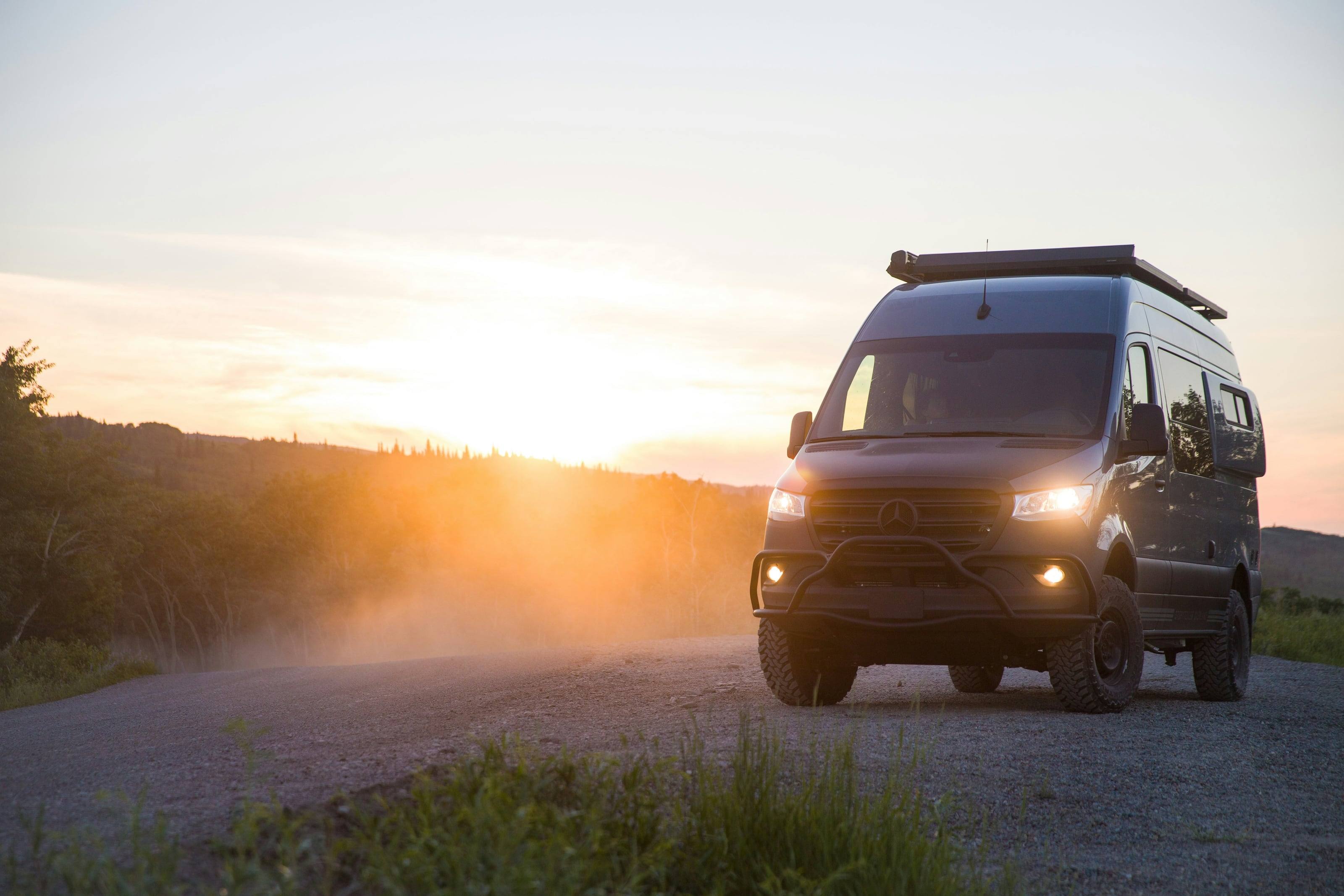
A Sprinter is not an off-road vehicle that happens to hold a bed. It is a commercial chassis with a tall box on it, sold in enough lengths, roofs and weight ratings that a builder can make almost anything fit. That flexibility is the whole appeal, and it is also the trap: the same catalogue that lets you stand up inside also lets you build something too long, too tall and too heavy for the roads you wanted it for.
This guide sticks to what Mercedes-Benz publishes for the current US model year, plus what its Operator’s Manual requires of you once the van is loaded. Payload and gross vehicle weight rating, the all-wheel-drive system and what it does not include, roof loads, diesel exhaust fluid, the altitude limit on the diesel engine, and the service the manual asks for when you drive dusty roads. Where a figure is not published, it is left out.
What the Sprinter does well for overland travel
The Sprinter is built to be converted, and the industry around it exists because of that. Mercedes-Benz Vans says more than 75 percent of all commercial Sprinters sold are turned into industry-specific vans by upfitters, and it names camper vans among the uses. That is why a Sprinter owner can find a shop in almost any western city that has cut that exact roof and knows where the factory attachment points are.
The second thing it does well is a combination other platforms make you choose between: full standing height, a sealed and insulated living space, highway manners, and a driven front axle when the surface turns. Mercedes-Benz describes a lineup offered with rear- or all-wheel drive and a maximum gross vehicle weight up to 12,125 lbs, with the 9G-TRONIC automatic across the range.
The third is that the load ratings are public: every configuration is published with its own payload and GVWR, so you can plan a build against a real number before anyone cuts metal.
Source 5
The van in numbers: roofs, lengths and what actually fits
The current US cargo van comes on three wheelbases: 144 inches, 170 inches, and a 170-inch extended, giving overall lengths of 234, 274 and 290 inches. Roofs are standard or high, which Mercedes-Benz translates into 68 inches or 79 inches of standing height inside. Cargo volume behind the seats runs from 319 cubic feet to 533 cubic feet.
Height is the figure that catches people. Mercedes-Benz lists overall heights up to 111 inches on a high-roof AWD van, before a rack, a fan or solar. Width with mirrors is 92 inches on 2500 models. A 144-inch van turns in a 45-foot circle curb to curb; the longer ones need more. Those numbers decide which forest roads you take, and no suspension kit changes them.
Choosing between the three lengths
- 01144-inch: fits a parking space, turns around on a two-track. Least floor area, most road access.
- 02170-inch: the common camper length. A fixed bed crosswise plus a garage, at the cost of rear overhang.
- 03170-inch extended: the most floor, and the version you will most often reverse out of somewhere.
- 04Standard against high roof: 68 or 79 inches inside, and outside, a foot of height and a halved roof load rating.
Source 1
Diesel, DEF and the altitude limit nobody mentions
The US Sprinter is a diesel, and the Operator’s Manual is specific: refill only with ultra-low sulfur diesel of maximum 15 ppm sulfur meeting ASTM D975. It notes a fuel preheating system that improves cold flow by about 14.5 °F, and warns that biodiesel above a 5 percent blend can clog the fuel filter.
Diesel exhaust fluid is not optional. The manual says the van must be operated with DEF for the exhaust aftertreatment to work, and that the engine management system detects running without it and will then prevent the engine from restarting after a warning. After the first refill warning, the remaining DEF is good for about 1200 miles and 16 further engine starts, counting down on the display, before the van limits itself to 5 mph. The tank holds 5.8 gallons and use runs 0 to 10 percent of fuel use.
The altitude line surprises people who live in the mountains. The manual states that operating safety of the diesel engine is assured up to an elevation of 2500 meters above sea level, that you may exceed it briefly over a pass, but that you should not drive continuously above it. That is roughly 8,200 feet, below a great many Colorado and Utah camps.
Do not skipBefore driving off pavement, the manual asks for at least 2.6 gallons of DEF in the tank, and for engine oil filled to maximum before extreme inclines. For water, it allows only what reaches the lower edge of the front bumper when calm, at walking pace, and says that after repeated fording at maximum depth all the oils in the major assemblies must be replaced.
Source 2
The generations worth knowing
Mercedes-Benz Vans dates the first-generation Sprinter to 1995 in Europe, where it won International Van of the Year. The second generation entered the European market in 2006. Its own history page puts the Mercedes-Benz Sprinter’s arrival in the US market at 2010, and marks 2018 as the year of the current van.
For a buyer, the line that matters is 2018 and after. That is the third-generation van, and it is the one current builders, parts and wiring diagrams are aimed at. Earlier vans are cheaper and people have lived in them for years, but parts availability, electrical architecture and upfitter support all improve at that break.
Mercedes-Benz does not publish a used-buyer guide, and this page does not invent one. What it can tell you is which years share a drivetrain, and that answer changed again for the 2023 model year.
Source 3
What changed for the 2023 model year
In March 2022 Mercedes-Benz Vans announced that the Sprinter would move to a fully four-cylinder lineup for the 2023 model year, with the OM654 diesel in two outputs, and that the 9G-TRONIC nine-speed automatic would become standard on all variants in place of the previous seven-speed. Shopping used, you are choosing between a six-cylinder van and a four-cylinder one.
The same announcement replaced the old part-time 4x4 with a new all-wheel-drive system. Mercedes-Benz describes automatic torque on demand with up to a 50 percent split per axle, where the previous engageable system sent 35 percent of torque forward and 65 percent rearward in 4x4 mode. It says the new system keeps the ground clearance and the approach, departure and breakover angles of its predecessor, though it does not publish those angles.
Read what that system is and is not. The Operator’s Manual calls it permanent drive to all four wheels with closed-loop control of torque between the axles, and says traction control for all-wheel drive also works through the brake system, which can overheat the brakes. There is no low range and no locking differential in the manual’s description: it is a traction aid for snow, mud and loose surfaces.
Source 4
Weight, which decides everything
Every choice in a van build spends payload. Mercedes-Benz publishes a figure for each configuration, and across the 2026 cargo van range they run from 3,351 lbs on a 2500 AWD extended high roof to 6,812 lbs on a 4500. A conversion with cabinetry, insulation, water, a battery bank and two people can consume most of the lower number before you load a cooler.
The manual is blunt about what to do with that: weigh the laden vehicle, including driver, passengers and payload, on a weighbridge, and the measured values must not exceed the maximums on the vehicle identification plate. It notes that only vehicles under 10,000 lbs gross weight carry the tire and loading placard on the B-pillar, so on a 3500XD or 4500 you read the identification plate instead.
Weigh axle by axle, not just in total. Vans put the kitchen and the batteries behind the rear axle, and a van can sit inside its GVWR while being over its rear axle rating.
What the manual asks you to respect once the van is built
- 01Gross vehicle weight rating and both axle ratings, from the identification plate, never exceeded including occupants.
- 02Maximum roof load: 661 lbs on a standard roof over six pairs of supports, 331 lbs on a high roof over three, no more than 110 lbs per pair.
- 03Cargo tie-down eyes in a cargo van are rated at 1798.5 lbf, with the load on two points and spread evenly.
Source 2
The upgrades that matter, in the order most owners need them
Buy in the order that failure will find you. Almost every Sprinter owner wants the same first four things, in roughly the same sequence, and it is not the sequence social media suggests.
Tires first, because a heavy van on light commercial tires is the most common way a trip ends. Match the load range to the axle weights you measured, not to the van’s empty weight, and accept that a taller or more aggressive tire costs fuel and speedometer accuracy. Suspension second, and only after the build is finished and weighed, because springs and dampers are chosen against a real corner weight.
Protection third: underbody and tank shielding, and attention to where the exhaust aftertreatment and DEF lines sit, since the manual is explicit that trapped rocks and branches can damage the suspension, fuel tank and brake system. Power fourth, sized from a measured daily load rather than a wish, and mounted low and between the axles. Storage last, because storage tempts you past the weight you just built around.
Two things not to buy early: a roof rack loaded to its limit on an already tall van, and a lift tall enough to change driveline angles.
Service before a long trip, and finding a shop that knows the van
Mercedes-Benz Vans publishes a basic limited warranty of 3 years or 36,000 miles, and a Sprinter powertrain warranty of 5 years or 100,000 miles. It advertises a service interval of up to 20,000 miles, and says following the schedule at an authorized service center keeps the van performing.
The manual then tells you that interval is not a promise. It lists arduous operating conditions that shorten it, and two describe overlanding exactly: frequent operation in mountainous terrain or on poor road surfaces, and operation in particularly dusty conditions. Under those it asks for the interior air filter, air filter, engine oil and oil filter to be changed more often. It also notes that short-distance driving loads the diesel particulate filter, and suggests 20 minutes of highway driving every 300 miles.
Before a long trip, run the manual’s own off-road checklist: fuel, DEF above the off-road minimum, engine oil at maximum if you expect steep ground, jack and wheel wrench with a wooden support, tread depth and tire pressures checked, and a tow rope, folding spade and chock aboard.
For work, use the directory. Sprinter van builders handle conversions and structural work. Diesel specialists understand the emissions system and what a DEF or particulate filter fault means on the road. Overland mechanics and RV and van service centers cover the crossover between chassis and house systems. Show suspension and tire shops your weighed numbers before they quote.
Source 6
Questions people ask
Is the Sprinter AWD system the same as four-wheel drive with low range?
No. Mercedes-Benz describes automatic torque on demand with up to a 50 percent split per axle, replacing the older engageable 4x4 that sent 35 percent front and 65 percent rear (source: mbusa-awd). The Operator’s Manual describes permanent drive to all four wheels with brake-based traction control, and does not describe a low range or a locking differential.
How much can a Sprinter actually carry once it is a camper?
Start from the payload published for your exact configuration, which ranges from 3,351 lbs to 6,812 lbs across the 2026 cargo van lineup (source: mbvans-cargo), then subtract the conversion. The only number that counts is the one you get by weighing the finished van, loaded, on a weighbridge, axle by axle.
Do I have to worry about DEF on a long remote trip?
Yes. The manual says the van must run on DEF, that after the first warning you have about 1200 miles and 16 restarts before it limits you to 5 mph, and that you should have at least 2.6 gallons in the tank before driving off pavement (source: mb-operators-manual). Carry a sealed container on long remote trips.
Can I camp at high altitude in a diesel Sprinter?
The Operator’s Manual states that operating safety of the diesel engine is assured up to 2500 meters above sea level, that you may exceed that briefly over a pass, and that you should not drive continuously above it (source: mb-operators-manual). Plan long stays and long climbs with that line in mind.
How much weight can I put on the roof?
The manual gives 661 lbs on a standard roof with six pairs of rack supports and 331 lbs on a high roof with three, with no more than 110 lbs per pair of supports, spread evenly (source: mb-operators-manual). A rack plus a tent plus panels reaches the high-roof limit faster than most people expect.
Which wheelbase should I build on?
Decide by the roads, not the floor plan. The 144-inch van is 234 inches long overall and turns in a 45-foot circle; the extended version is 290 inches (source: mbvans-cargo). Longer gives floor space and costs you access, turning room and rear overhang clearance.