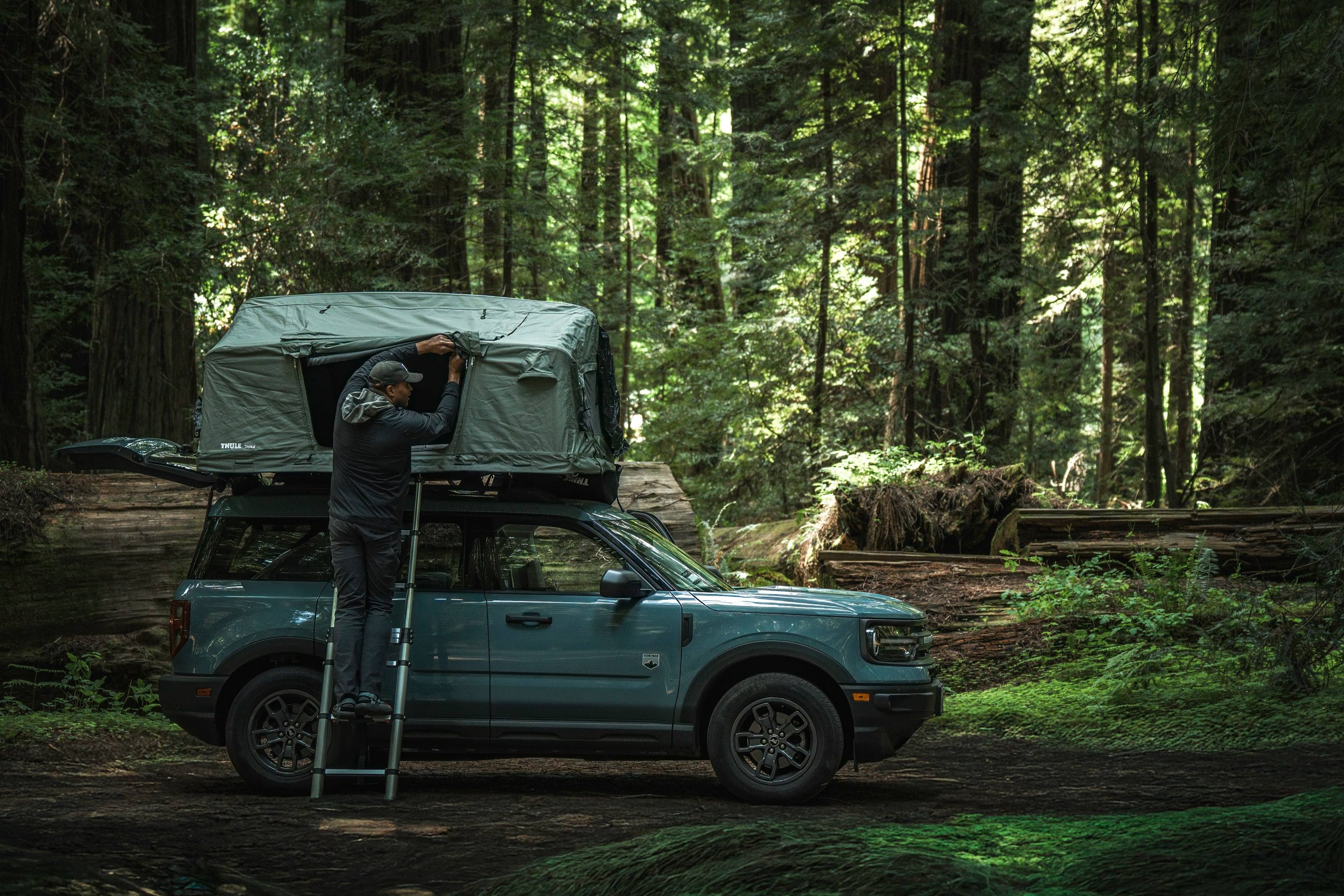
A roof tent is the most visible decision in a build and one of the few that changes how the vehicle drives every mile, loaded or not. A ground tent changes nothing about the vehicle and everything about how camp works. Sleeping inside is the quietest of the three and the one with the real hazard.
This guide covers what each one asks of you, the roof load figures you must look up for your own vehicle, and the two things that hurt people: weight high up, and burning fuel in an enclosed space.
The two roof numbers, and why they differ
Every vehicle has a dynamic roof load: the maximum weight permitted on the roof while driving. Many also have a static load, which is what the roof will carry parked, with people in the tent. Thule, which makes racks and tents, defines them exactly that way and adds that static weight can exceed dynamic weight, giving as a guideline that the static capacity of its roof racks is three times the dynamic capacity.
Rivian publishes both figures for its own vehicles: "the maximum dynamic (driving) load is 250 lbs (113 kg) per crossbar pair", and "the maximum static (parked) load is 780 lbs (353 kg)", naming a rooftop tent at a campsite as the example. That is the shape of the answer on most vehicles, but the numbers are yours to look up, not to borrow.
Find your own two figures before you buy anything. Ford tells owners their roof rack load limit is in the Load Carrying section of the owner's manual, and warns: "Never place loads directly on the roof panel. The roof panel is not designed to directly carry a load." If your vehicle has a panoramic glass roof, Thule says to check with the manufacturer before fitting a tent at all.
Do not skipThe dynamic figure is the one that governs driving, and it includes the rack and the tent, not just the tent. Exceeding it is not a theoretical problem: the load is bolted to the top of the vehicle at head height.
Source 1
The rack under the tent
A roof tent is only as sound as what it sits on. Thule's guidance is to use a rooftop tent only on raised rails that are supported, because unsupported rails "are usually too flexible to handle the static load of a tent with people inside", and to position the crossbars as close to the vehicle's support structure as possible to minimise flexing.
Racks are systems, and a system is as strong as its weakest part: bars, feet and fit kits can each have a different capacity, and the lowest of them sets the limit for the whole thing. For a factory rack, or another maker's, read that maker's manual rather than assuming.
Source 1
What weight up high does
Everything you put on the roof sits above the centre of gravity, and the effect is out of proportion to the pounds. Rivian's own wording is the plainest: "Vehicle handling, cornering, braking, and sensitivity to side winds change with rooftop loads", and the driver is responsible for adjusting speed to the load, the road and the wind. Ford says the same in fewer words: loaded vehicles with higher centres of gravity may handle differently, so lower your speed and increase stopping distance.
In practice you will notice three things. The vehicle leans later and further into a corner and settles more slowly. A crosswind on an interstate, or the bow wave of a passing truck, moves you in the lane. And on an off-camber track, the angle at which the vehicle feels uncomfortable arrives sooner than it used to.
None of that is a reason not to fit a tent. It is a reason to drive the loaded vehicle gently for the first hundred miles and learn what it now does.
Source 2
Choosing between the three
A roof tent sets up in a couple of minutes, keeps you off wet, rocky or thorny ground, and needs no flat clearing. The costs are the ones above, plus this: every time you want to drive somewhere, camp comes down. Hard shells go up fastest and are quietest in wind; soft shells are lighter and usually bigger when open.
A ground tent leaves the vehicle unchanged, costs the least, and lets you leave camp standing while you drive out for the day. It needs ground you can sleep on and stakes that will hold in it, and it is the slowest to dry.
Sleeping inside the vehicle is the warmest, quietest and most secure option, and the fastest of all in bad weather, at the cost of the space it permanently takes up. An awning is not shelter for sleeping but it is the cheapest comfort on the list: shade for the kitchen and a dry place to stand while it rains.
Questions that decide it
- 01What are your vehicle's dynamic and static roof loads, from its own manual?
- 02Do you want to leave camp set up while you drive for the day?
- 03How often will you move camp: nightly, or once a week?
- 04How much of your travel is in wind, and how much on rough tracks where weight up high matters most?
- 05Will you sleep in freezing weather, and if so how will the space be heated and ventilated?
Wind, condensation and cold
Wind is the thing that ends nights. Point the narrow end of a tent into the prevailing wind, use every guy line rather than the minimum, and choose the lee of a hill or a stand of trees over the view. A roof tent in a strong wind is loud whatever you do, and a hard shell is markedly quieter than fabric.
Condensation is a function of breath and cooking against cold fabric or metal, and the only cure is ventilation. Leave a vent open at each end even when it is cold. In a vehicle, that means cracking two windows on opposite sides, not one.
For lightning, the National Weather Service is unambiguous, and it is not the answer most campers expect: "a tent offers NO protection from lighting", and neither does an open-sided shelter. If thunder arrives, go to a hard-topped metal vehicle with the windows closed and wait 30 minutes after the last rumble before returning to camp. If you are camped in open country, pitch in a valley, ravine or other low ground.
Source 4
Carbon monoxide: the hazard that kills campers
The Consumer Product Safety Commission publishes the bare fact: "People die every year from carbon monoxide poisoning from the use of portable camping heaters, lanterns, or stoves inside tents, campers, and vehicles." Its rule is absolute. Do not use portable heaters or lanterns while sleeping in an enclosed space such as a tent, a camper or a vehicle, and be especially careful at altitude, where the risk is greater.
The CDC describes carbon monoxide as "an odorless, colorless gas that kills without warning", produced any time you burn fuel. Its symptoms, headache, dizziness, weakness, upset stomach, vomiting, chest pain and confusion, are so like the flu that they are routinely mistaken for it. People who are asleep or have been drinking can die before they have symptoms at all.
So: cook outside or under an awning, never in a closed vehicle or tent. Run a fuel-burning heater only if it is a sealed unit with its exhaust outside, installed properly. Fit a carbon monoxide alarm in any vehicle people sleep in, and replace it per its instructions or every five years. And if someone develops cold or flu-like symptoms while camping, get them into fresh air and see a doctor.
One more, for winter and for anyone who sleeps with the engine running. The Weather Service tells stranded drivers to run the motor about ten minutes each hour for heat, open a window a little for fresh air, and clear snow from the exhaust pipe. A blocked exhaust fills the cabin.
Do not skipNever burn anything inside a closed tent or vehicle: not a stove, not a lantern, not charcoal, not a flameless chemical heater. Carbon monoxide has no smell, and the people most likely to die of it are asleep.
Source 6
Where to buy and have it fitted
Roof tent dealers and outfitters sell and usually fit them. A rack that has to carry a static load with people in it, or a platform bed and insulation inside a van, is fabrication and interior work: the fabricators and builders in the directory do that.
Ask any fitter for two figures in writing: what the finished rack and tent weigh, and what your vehicle's dynamic roof load is. If they cannot give you both, find someone who can.
Questions people ask
What roof load do I need for a roof tent?
Two figures from your own vehicle's manual: the dynamic load, which is the maximum while driving and must cover the rack plus the tent, and the static load with people inside while parked. Rivian, for example, publishes 250 pounds dynamic and 780 pounds static per crossbar pair.
Why is the static roof load so much higher than the dynamic one?
Because a parked vehicle is not braking, cornering or hitting bumps. Thule gives a guideline that the static capacity of its racks is three times the dynamic capacity, but use your own vehicle's published figures.
Can I put a roof tent on a panoramic glass roof?
Only if the vehicle manufacturer says so. Thule tells owners of vehicles with glass or large panoramic roofs to always check with the manufacturer first.
Is it safe to use a heater in a tent?
No. The Consumer Product Safety Commission says not to use portable heaters or lanterns while sleeping in tents, campers or vehicles, and that people die every year doing it. Only a sealed heater with its exhaust outside the living space belongs in a vehicle.
Is a tent safe in a thunderstorm?
No. The National Weather Service says a tent offers no protection from lightning, and neither does an open-sided shelter. Get into a hard-topped metal vehicle with the windows closed, and wait 30 minutes after the last thunder.