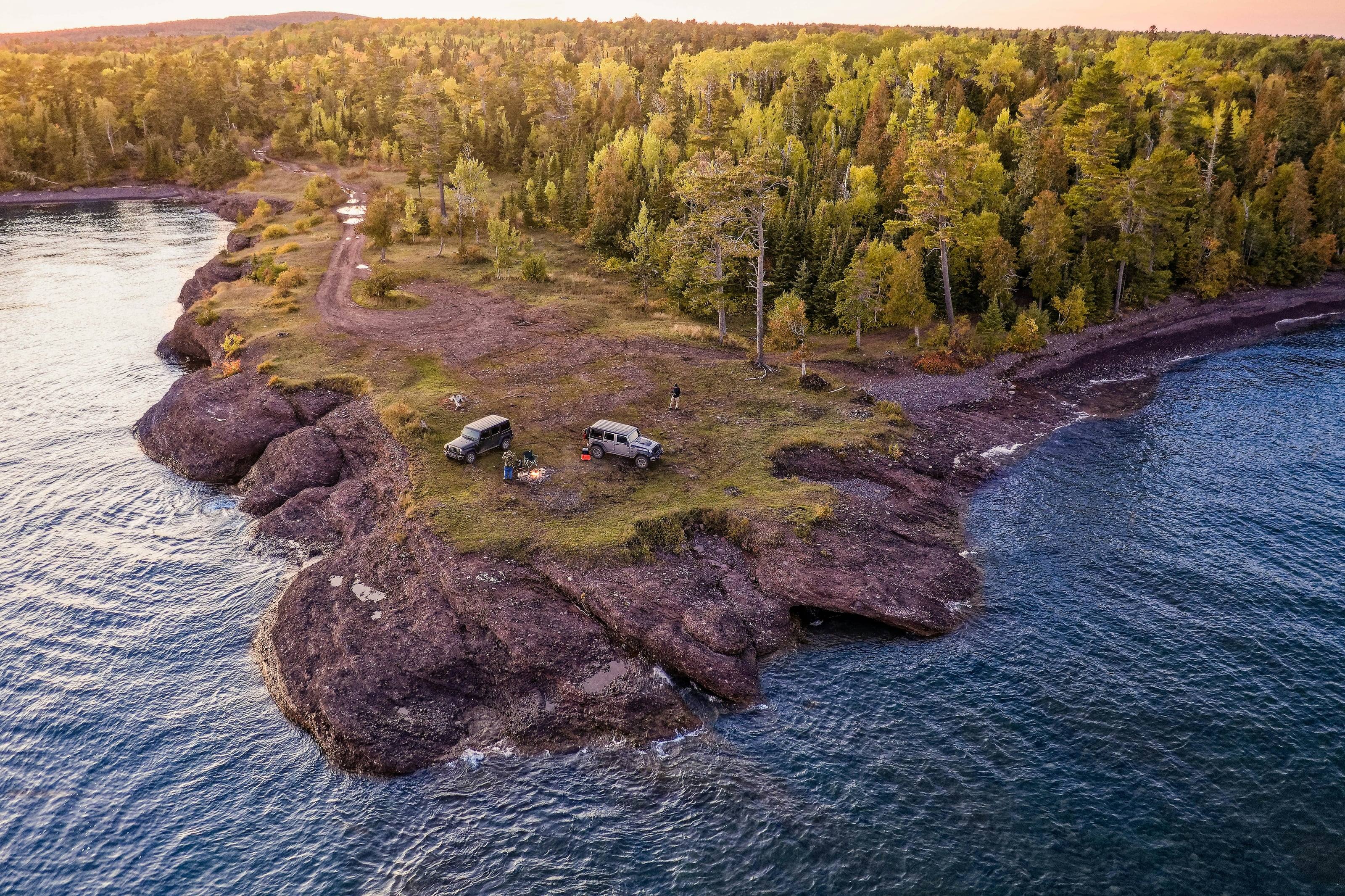
Two vehicles camped on a rocky point above a big lake, seen from the air, the first fall color in the trees.

The Overland Directory

Overland builders in Ohio

Shops that take a stock truck, SUV or van and turn it into a vehicle you can live out of for a week or a year.

Overland builders in Ohio

1 listing

  1. Trailhead 4x4 LLC Valley View, OH Land Rover shop handling oil changes, brakes, suspension rebuilds and engine swaps, fitting winches, racks, lighting and second batteries, and taking on frame up custom builds.

Ohio by the numbers

Acres of federal land 1
305,753
1.2 percent of Ohio. The BLM manages none of it
Acres of national forest, all of it the Wayne 1
244,357
Ohio has one national forest. It describes itself as a patchwork of over a quarter million acres in three units
Federal campgrounds a vehicle can reach 2
6
Three at Lake Vesuvius in the Wayne, three at Corps of Engineers lakes. Four can be booked ahead
Acres in Cuyahoga Valley National Park 31
33,000
No entry gates and no fee. No camping is permitted anywhere in the park
State forests, covering more than 200,000 acres 17
24
The Division of Forestry runs four all-purpose vehicle areas on them
Miles of off-highway vehicle trail on the Wayne 8
145
The forest calls it the largest OHV trail system in Ohio. Its passes page says nearly 150 miles
Width limit on a state forest APV trail 19
62 in
The Wayne holds its trails to 50 inches. Neither figure describes a full-size truck
Campbell Hill, the highest point in Ohio 3
1,550 ft
Logan County. Our own 3DEP query at the summit reads 1,548 feet. The low point is about 455 feet on the Ohio River

What Ohio asks of a build

Nothing here is about altitude. Towns in this guide run from 534 feet at Portsmouth to 1,245 at Bellefontaine, and the state high point is 1,550. What Ohio tests is water, mud and width. The forest that holds most of the federal land warns that springs are rainy, that flooding is common, that some roads have restricted access or close, and that its own designated routes may be unmaintained dirt passable only by a high-clearance vehicle.

Width is the second brief. A full-size truck is welcome on forest roads, byways and Corps lake camps, and it is too wide for both the Wayne trails at 50 inches and the state forest APV areas at 62. Decide early which of those two vehicles you are building, because the answer changes everything from tire size to whether you tow a machine behind you.

The full guide to overlanding Ohio

What an overland builder does

A builder plans and installs the whole system rather than one part of it: suspension matched to the finished weight, protection where the vehicle actually touches the ground, electrical power sized to what you run, and storage, water, sleeping and recovery points that work together. The good ones start with how you travel and work backward to parts.

The work that matters most is the work you cannot see. Wiring that is fused, labeled and documented. Fasteners that stay tight on washboard. A finished weight that stays inside what the vehicle is rated to carry.

Most full builds cover

  1. 01Suspension and tires chosen for the loaded weight
  2. 02Bumpers, sliders, skid plates and rated recovery points
  3. 03House battery, charging, solar and lighting
  4. 04Storage, drawers, fridge and water
  5. 05Sleeping: a roof tent, a camper or an interior platform
  6. 06Mounts for communications and navigation

How to choose a builder

Any shop can show you a finished truck in good light. These questions tell you how it was built.

  1. 01Ask to see finished builds on your platform, and talk to an owner who has put miles on one if you can.
  2. 02Ask what the vehicle will weigh when it is done and how that compares to its gross vehicle weight rating. A builder who cannot answer has not done the math.
  3. 03Ask who does the electrical work and whether you get a wiring diagram at handover.
  4. 04Ask what is done in house and what is sent out.
  5. 05Get the scope, the parts list, the price and the payment schedule in writing before work starts, and ask how changes are handled.
  6. 06Ask what warranty covers their labor, separate from the manufacturers' warranties on parts.

What to have ready before you ask for a quote

A builder can only quote what you can describe. The form on this page asks for exactly these things, which is why a quote that comes back from it is worth something.

  1. 01Year, model, engine and drivetrain, and for vans the wheelbase and roof height
  2. 02What has already been done to it
  3. 03How you travel: weekends or months, how many people, which climates, how far from pavement
  4. 04What you need to carry: water, fuel, bikes, boats, tools
  5. 05A budget range and a date you would like it back

Questions people ask

How much does an overland build cost?

It depends on scope more than on the vehicle. Suspension, tires and a roof tent is a different project from a full electrical system with cabinetry and armor, and labor is usually the largest part of a full build. The only number worth planning around is a written quote against a defined scope, which is what the form on this page is for.

How long does a build take?

Bolt-on work can be days. Full builds take longer, and at busy shops the wait for a start date can be longer than the work itself. Ask every shop for both numbers: when they can start and how long they need the vehicle.

Should I build in stages or all at once?

Stages work if the order is right. Decide the finished load first, because springs chosen for an empty truck will be wrong for a full one. Run electrical before interiors go in, because pulling cabinets to add a wire is paying for the same work twice.

Will modifications affect my warranty or insurance?

They can. Ask the builder which work they have seen raise warranty questions on your platform, read your warranty terms, and tell your insurer what has been added so the build is covered for its real value.

How high is Ohio?

From Portsmouth at 534 feet to Campbell Hill at 1,550. Altitude decides what your engine, your brakes and your lungs have to work with, and how late in the year the passes open.

Towns

  1. Bellefontaine Logan County, at 1,245 feet the highest of the towns in this guide. Campbell Hill, the state high point at 1,550 feet, is just east of town. 1,245 ft
  2. Woodsfield Monroe County seat and the north end of the Covered Bridge Scenic Byway on SR 26. 1,204 ft
  3. Loudonville In the Mohican valley. Mohican-Memorial State Forest, the one state forest besides Maumee where snowmobiles may use designated trails, is a few miles south at Perrysville. 974 ft
  4. New Lexington Perry County seat, the nearest town of any size to the Perry State Forest APV area, which the Division of Forestry calls the most popular public riding area in Ohio. 956 ft
  5. New Straitsville In Perry County on SR 595. The New Straitsville OHV trailhead is two miles south, one of two on Monday Creek with loading ramps. 793 ft
  6. McArthur Vinton County seat on US 50. Gateway to Zaleski State Forest, the second largest, and its backpack camps. 763 ft
  7. Peninsula In the Cuyahoga Valley between Cleveland and Akron, inside the national park’s 33,000 acres and on the Ohio and Erie Canalway Byway. No camping anywhere in the park. 754 ft
  8. Logan On US 33 at the gateway to Hocking Hills. Hocking State Forest and the Hocking Hills Scenic Byway both leave town on state routes. 740 ft
  9. Athens Where US 33 meets US 50 on the edge of the Athens Unit. The Forest Service names it as one of three cities that make a good place to start or end a visit, for lodging and dining. 719 ft
  10. Jackson Jackson County seat, one of the four counties in the Ironton Ranger District, between the Pine Creek OHV system and Richland Furnace State Forest. 688 ft
  11. Swanton Northwest Ohio, southwest of Toledo. Maumee State Forest and its APV area, the only one of the four that stays open through winter. 684 ft
  12. Nelsonville On US 33 about 70 miles southeast of Columbus. Wayne National Forest headquarters, welcome center and the Athens Ranger Station. Monday Creek OHV trails start just north. 679 ft
  13. Chillicothe On US 23 and US 50. The Division of Forestry’s Chillicothe district office, and the way in to Scioto Trail and Tar Hollow state forests. 634 ft
  14. Marietta At the mouth of the Muskingum on the Ohio River. South end of the Covered Bridge Scenic Byway and home of the Wayne’s Marietta field office. 612 ft
  15. Ironton On US 52 at the Ohio River, at the edge of the Ironton Ranger District. Lake Vesuvius and its three campgrounds are 6.5 miles north on SR 93. 551 ft
  16. Portsmouth Where US 23 meets US 52. Shawnee State Forest, the largest in the state, starts just west on US 52. 534 ft

Passes, high roads and summits

  1. Campbell Hill The highest point in Ohio, in Logan County. Our own 3DEP reading at the USGS point is 1,548 feet 1,550 ft
  2. Mount Logan Ross County, above the Scioto valley at Chillicothe. Measured for this chart; no agency publishes a figure for it 1,246 ft

Pass, road and summit elevations are the figures published by the agency that manages them. Town elevations are the town’s or county’s own figure where it publishes an exact one; the rest are from the U.S. Geological Survey (3D Elevation Program at the place’s official coordinates), retrieved September 18, 2026. Every source is listed at the foot of the page.

Free build quotes

Looking for overland builders in Ohio? Tell us about the project and get free quotes.

Tell us about your project

Free build quotes

Tell us about your project

What are you building on?

Do you have it yet?

What do you want done?

Choose everything that applies.

What are you working with?

Budget for this work

When you want it done

A range is enough. It tells a builder which conversation to have with you.

Where should the shop be?

How far will you go for the right shop?

Where should the quotes go?

Best way to reach you

Free, and no obligation. We use these details only to connect you with builders. See our privacy page.

Sources for this page

35
  1. Congressional Research Service. Federal Land Ownership: Overview and Data (R42346), Tables 1 and 2, data as of September 30, 2024. Retrieved September 19, 2026.
  2. Recreation.gov. Recreation Information Database (RIDB) full export. Our count of federal campgrounds in Ohio a vehicle can reach. Retrieved September 19, 2026.
  3. U.S. Geological Survey. Elevations and Distances in the United States, online edition, Highest and Lowest Elevations table. Retrieved September 19, 2026.
  4. U.S. Geological Survey. Geographic Names Information System and 3D Elevation Program point query. Elevation of the 3DEP surface at the GNIS coordinates of the named place, rounded to the nearest foot. Retrieved September 19, 2026.
  5. USDA Forest Service, Wayne National Forest. Wayne National Forest home page. Retrieved September 19, 2026.
  6. USDA Forest Service, Wayne National Forest. About the Area: what to expect when visiting, and climate. Retrieved September 19, 2026.
  7. USDA Forest Service, Wayne National Forest. Recreation, including the 2026 Seasonal Recreation Dates. Retrieved September 19, 2026.
  8. USDA Forest Service, Wayne National Forest. Off-Highway Vehicles (OHV), including the 2026 trail systems and rules. Retrieved September 19, 2026.
  9. USDA Forest Service, Wayne National Forest. Passes and Permits: off-highway vehicle trail passes. Retrieved September 19, 2026.
  10. USDA Forest Service, Wayne National Forest. Motor Vehicle Use Maps, Athens, Ironton and Marietta units, 2026. Retrieved September 19, 2026.
  11. USDA Forest Service, Wayne National Forest. Forest-Wide Restriction: Occupancy and Use, Order 09-14-24-03, signed May 2, 2024. Retrieved September 19, 2026.
  12. USDA Forest Service, Wayne National Forest. Monday Creek OHV System. Retrieved September 19, 2026.
  13. USDA Forest Service, Wayne National Forest. Hanging Rock Recreation Area. Retrieved September 19, 2026.
  14. USDA Forest Service, Wayne National Forest. Pine Creek OHV System, with the Telegraph Trail closure order. Retrieved September 19, 2026.
  15. USDA Forest Service, Wayne National Forest. Covered Bridge Scenic Byway. Retrieved September 19, 2026.
  16. USDA Forest Service, Wayne National Forest. Lake Vesuvius Recreation Area. Retrieved September 19, 2026.
  17. Ohio Department of Natural Resources, Division of Forestry. Ohio State Forests Guide, brochure updated October 8, 2024. Retrieved September 19, 2026.
  18. Ohio Department of Natural Resources. Division of Forestry: state forest camping reservations, seasonal bridle trail closure and APV trail notices. Retrieved September 19, 2026.
  19. Ohio Department of Natural Resources, Division of Forestry. APV Trails in State Forests, quoting OAC 1501:3-4-15 and ORC 4519.09 and 4519.11. Retrieved September 19, 2026.
  20. Ohio Department of Natural Resources. Perry State Forest. Retrieved September 19, 2026.
  21. Ohio Department of Natural Resources. Pike State Forest. Retrieved September 19, 2026.
  22. Ohio Department of Natural Resources. Richland Furnace State Forest. Retrieved September 19, 2026.
  23. Ohio Department of Natural Resources. Maumee State Forest. Retrieved September 19, 2026.
  24. Ohio Department of Natural Resources. State Park Rules: Activities Not Allowed at Ohio State Parks, and Camping Rules for Ohio State Parks (OAC 1501:46-3 and 1501:46-9). Retrieved September 19, 2026.
  25. Ohio Department of Natural Resources, Division of Forestry. Open Burning Regulations, citing Ohio Revised Code 1503.18. Retrieved September 19, 2026.
  26. Ohio Bureau of Motor Vehicles. New Vehicle Registration: All-Purpose Vehicles (APV), Off-Highway Motorcycles, and Snowmobiles, citing ORC 4503.37. Retrieved September 19, 2026.
  27. Ohio Department of Transportation. Snow and Ice: winter maintenance responsibility. Retrieved September 19, 2026.
  28. Ohio Department of Transportation. Ohio Byways: Ohio River Scenic Byway. Retrieved September 19, 2026.
  29. Ohio Department of Transportation. Ohio Byways: Hocking Hills Scenic Byway. Retrieved September 19, 2026.
  30. Ohio Department of Transportation. Ohio Byways: Ohio and Erie Canalway Byway. Retrieved September 19, 2026.
  31. National Park Service, Cuyahoga Valley National Park. Frequently Asked Questions. Retrieved September 19, 2026.
  32. National Park Service, Cuyahoga Valley National Park. Camping. Retrieved September 19, 2026.
  33. U.S. Fish and Wildlife Service. Ottawa National Wildlife Refuge. Retrieved September 19, 2026.
  34. U.S. Army Corps of Engineers. Corps Lakes Gateway: Ohio. Retrieved September 19, 2026.
  35. Office of the Federal Register. 36 CFR 327.7, Camping (Corps of Engineers water resources development projects). Retrieved September 19, 2026.

Reviewed September 19, 2026. Conditions, closures and rules change; check with the managing agency before you travel.