The White Rim Road loops around and below the Island in the Sky mesa, the district of Canyonlands National Park nearest Moab. The National Park Service (NPS) puts it at 100 miles, says most four-wheel-drive parties take two to three days, and rates it moderately difficult for the right vehicle in good weather.
It is also tightly managed. Every vehicle needs a permit, for a day or for a week. Camping is only in 20 designated sites. Pets, wood fires, generators, drones and off-highway vehicles are all banned. This page sets out what NPS publishes, so you can plan around the rules rather than meet them at the gate.
What the White Rim Road is, and why people drive it
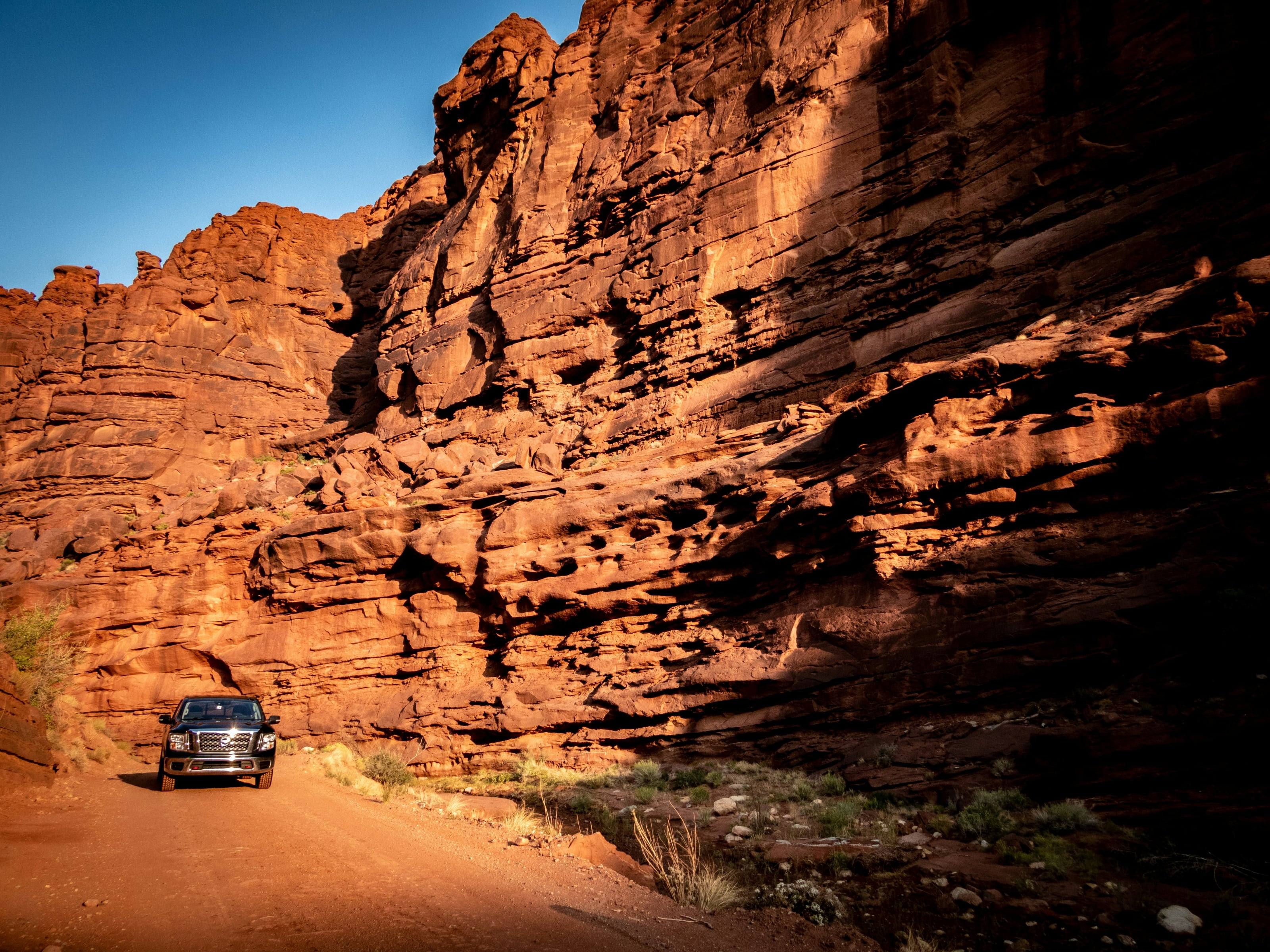
The White Rim Road is the long way around Island in the Sky. NPS describes a 100-mile road that loops around and below the mesa top, with expansive views of the surrounding country, and says four-wheel-drive trips usually take two to three days.
In favorable weather NPS rates it moderately difficult for high-clearance, four-wheel-drive vehicles. It names the hard parts: the Shafer Trail, Lathrop Canyon Road, Murphy Hogback, Hardscrabble Hill and the Mineral Bottom switchbacks are steep and exposed, and NPS asks for extreme caution on them in bad weather.
People drive it for the scale as much as the difficulty: days of slow travel with no services, a fixed number of parties on the road, and camps that NPS says are generally placed out of earshot of each other.
Source 1
The route in the order you drive it
NPS lists the camps clockwise from the Island in the Sky Visitor Center, and this follows the same order. From the mesa top the Shafer Trail drops to the rim. NPS’s Auto Touring page says it descends 1,500 feet through a sandstone cliff and reaches a junction after 5.2 miles, where the road splits into the White Rim Road and Potash Road. NPS asks you to close and latch the gate at that junction behind you.
You do not need a permit for the Shafer Trail or Potash Road. From the junction on, you do. For a day trip, NPS suggests driving a couple of hours in from either access point and turning around, which still reaches features such as Musselman Arch.
The road then runs the east side to White Crack, and the west side, the Green River side, over Murphy Hogback and Hardscrabble Hill toward the Mineral Bottom Road. The Mineral Bottom switchbacks are the last of the steep sections NPS names.
Camping areas clockwise, with NPS’s distance and estimated drive time from the visitor center
- 01Shafer: 7 miles, 30 minutes, 1 site
- 02Airport (A to D): 19 miles, 1.5 hours, 4 sites
- 03Gooseberry (A and B): 30 miles, 3 hours, 2 sites
- 04White Crack: 39 miles, 4 hours, 1 site
- 05Murphy Hogback (A to C): 45 miles, 5.5 hours, 3 sites
- 06Candlestick: 55 miles, 7 hours, 1 site
- 07Potato Bottom (A to C): 66 miles, 8.5 hours, 3 sites
- 08Hardscrabble (A and B): 70 miles, 9.5 hours, 2 sites
- 09Labyrinth (A and B): 72 miles, 10 hours, 2 sites
- 10Taylor: 77 miles, 11 hours, 1 site
Source 1
What NPS requires of the vehicle and the driver
The rule is not a recommendation. NPS requires high clearance and four-wheel drive with a low range gear (4LO) on the White Rim Road. Its road conditions page names what does not qualify: all-wheel-drive vehicles, and two-wheel-drive vehicles of any clearance. They have difficulty with the rough slickrock, loose rocks, deep sand and steep switchbacks, NPS says, and are not permitted on the road.
Size matters too. NPS gives maximum recommended dimensions of 8 feet wide and 9.5 feet tall, and says vehicles higher than 9 feet 6 inches are not recommended because of overhangs.
ATVs, UTVs and OHVs are not allowed, even if street legal. Motorcycles must be equipped and licensed for interstate travel. Every vehicle must be registered and driven by a licensed driver. NPS tells drivers to be prepared to self-rescue, and says towing from the backcountry is very expensive.
What NPS says every backcountry driver should carry
- 01At least one full-size spare tire
- 02Extra gas
- 03Extra water
- 04A shovel
- 05A high-lift jack
- 06Chains for all four tires, especially from October through April
Do not skipAll-wheel drive does not meet the rule. NPS requires high clearance and a low range gear, and says vehicles without them are not permitted on the White Rim Road.
Source 4
Day-use permits
Every vehicle, motorcycle and bicycle on the White Rim for a single day needs its own day-use permit. A party with an overnight permit does not need one as well.
NPS issues day-use permits for 50 vehicles, motorcycles included, and 50 mountain bikes each day. They can be booked on Recreation.gov from 8 a.m. Mountain Time the day before the trip. Permits for 25 of the 50 vehicles are held back and issued in person at visitor centers on the day, up to one hour before closing. Groups are limited to three vehicles and 15 bicycles, and larger groups must travel 30 minutes apart.
As of September 2026, NPS lists a $6 Recreation.gov reservation fee for a permit booked online and no fee for one issued at a visitor center. The park entrance fee is separate. If your plan does not pass a visitor center, or starts before one opens, NPS says you must get the permit online the day before.
One day is a long day. NPS says to plan for a minimum of 10 to 12 hours of driving or cycling, and its Auto Touring page advises against driving the whole loop in a day, because it means many hours of very bumpy travel at 15 mph or less.
Source 2
Overnight permits and the camps
Camping is only in the 20 designated sites, and only with an overnight backcountry permit that names them. Each site takes up to 15 people and three vehicles, and NPS counts motorcycles and trailers as vehicles. Keep all of camp inside the posts that mark the site.
A permit can cover up to 14 consecutive nights, with no more than three consecutive nights at any one vehicle camping area. Permits open on Recreation.gov by season, four months ahead, at 8 a.m. Mountain Time.
NPS says White Rim permits in spring and fall are very competitive, and recommends applying as early as possible. Reservations close two days before a trip starts. Sites still unreserved then are issued as walk-up permits, in person at visitor centers, until 2:30 p.m. Mountain Time.
As of September 2026, NPS lists a non-refundable $36 reservation fee per permit, which includes the $6 Recreation.gov fee, plus $5 per person per night. Entrance fees are separate.
When overnight permits open
- 01Spring trips (March 10 to June 9): November 10
- 02Summer trips (June 10 to September 9): February 10
- 03Fall trips (September 10 to December 9): May 10
- 04Winter trips (December 10 to March 9): August 10
Source 3
Fuel, water and services
There are none on the road. NPS says there is no food, lodging or gas in Canyonlands, and that the nearest services to Island in the Sky are in Moab, 32 miles from the visitor center. Count the loop’s 100 slow miles on top of that and carry fuel to match.
There is no potable water along the White Rim Road. NPS says to bring at least one gallon per person per day, and more if you will be active. At Island in the Sky it lists water outside the visitor center spring through fall and inside during business hours, and none at the mesa-top campground. Confirm before you rely on it.
Do not count on a phone. NPS reports very limited service on the east side of the road and none on the west side, between White Crack and the Mineral Bottom Road.
Source 6
Hazards and season
NPS calls spring (April through May) and fall (mid-September through October) the temperate and most popular seasons, with daytime highs averaging 60 to 80 degrees Fahrenheit and lows of 30 to 50. Summer often exceeds 100 degrees, and the late summer monsoon brings violent storm cells that often cause flash floods. Winter highs average 30 to 50 degrees and lows 0 to 20, and NPS notes that even a little snow or ice can make local roads impassable. The road has little shade.
The Green River is the other clock. NPS’s High Water page says high water typically lasts from mid-May through mid-June. Once the river exceeds 17,000 cubic feet per second, the west side is likely to flood in several places between the Hardscrabble camps and the northwest park boundary. Above 20,000, NPS says the road may be closed from the base of Hardscrabble Hill to the boundary, which makes a complete loop impossible.
NPS tells every party in that period to carry extra food, fuel and water in case they have to leave by the Shafer Trail or Potash Road. Driving off the road to get around flooded sections is prohibited.
Do not skipIn high water season, plan as if you will have to turn around on the west side and drive back the way you came. NPS says that can add up to 80 miles to a trip.
Source 7
Leaving it as you found it
NPS prints its backcountry regulations on every permit. The ones that matter most on this road are below.
NPS lists toilets at every White Rim camping area. Its regulations also require a reusable toilet system or commercial waste bags when camping within half a mile of the Green or Colorado rivers, so ask the Backcountry Permit Office how that applies to the sites on your permit.
From the Canyonlands backcountry regulations and the White Rim page
- 01All vehicles, motorcycles and bikes stay on designated roads.
- 02No pets, even inside a vehicle.
- 03No wood campfires. The regulations allow charcoal in a fire pan at vehicle campsites, packed out afterward, while the White Rim page says simply that fires are not permitted. Ask before you bring charcoal.
- 04No generators and no drones.
- 05Pack out all garbage, including toilet paper.
- 06Keep camp inside the site boundary. Quiet hours are 10 p.m. to 6 a.m.
- 07No camping within 300 feet of an archeological site, historic site or water source.
- 08Leave natural objects and artifacts where they are, and do not touch rock art.
- 09Do not climb, stand or walk on any arch.
Source 9
Questions people ask
Do I need a permit to drive the White Rim Road?
Yes. NPS requires a permit for every trip: a day-use permit for each vehicle, motorcycle and bicycle on a single-day trip, or an overnight backcountry permit if you camp. The Shafer Trail and Potash Road do not need one.
Can I drive the White Rim Road in an all-wheel-drive SUV?
No. NPS requires high clearance and four-wheel drive with a low range gear, and says all-wheel-drive and two-wheel-drive vehicles are not permitted on the White Rim Road.
How long does the White Rim Road take?
NPS says four-wheel-drive trips usually take two to three days. It advises against driving the whole 100 miles in one day, and says to plan for a minimum of 10 to 12 hours of driving.
Is there water or fuel on the White Rim Road?
No. There is no potable water along the road and no fuel anywhere in Canyonlands. NPS says the nearest services to Island in the Sky are in Moab, 32 miles from the visitor center, and recommends at least one gallon of water per person per day.
Can I bring my dog on the White Rim Road?
No. NPS does not permit pets on the White Rim Road, even inside a vehicle. Its Auto Touring page says dogs may travel in vehicles on the Shafer Trail and Potash Road, which need no permit.
When does the White Rim Road flood?
NPS says high water on the Green River typically lasts from mid-May through mid-June. Above 17,000 cubic feet per second the west side is likely to flood in places, and above 20,000 the road may be closed from Hardscrabble Hill to the park boundary.
 Bureau of Land Management (BLM)
 US Forest Service (USFS)
 National Park Service (NPS)
 US Fish and Wildlife (USFW)
 Bureau of Reclamation (USBR)
 Department Of Defense (DOD)
 Bureau of Indian Affairs (BIA)
 Other Federal
 State
 Local
 Alaska Native Lands (Patented or Interim Conveyed)
 Alaska Native Allotment
 Road
 Primitive Road
 Road
 Primitive Road
 Trail
 Roads open to all Vehicles, Yearlong
 Roads open to all Vehicles, Seasonal
 Roads open to highway legal vehicles only, Yearlong
 Roads open to highway legal vehicles only, Seasonal
 Special Designation, Yearlong
 Special Designation, Seasonal
 Trails open to all vehicles, Yearlong
 Trails open to all vehicles, Seasonal
 Trails open to vehicles 50" or less in width, Yearlong
 Trails open to vehicles 50" or less in width, Seasonal
 Trails open to motorcycles, Yearlong
 Trails open to motorcycles, Seasonal
 Special Designation, Seasonal
 Trails Open to Wheeled Vehicles Only < 50" in Width, Yearlong
 Trails Open to Wheeled Vehicles Only < 50" or Less in Width, Seasonal
 Wilderness Area
 Wilderness Study Area