Cathedral Valley is the quiet end of Capitol Reef. The loop leaves Highway 24 east of the visitor center, fords the Fremont River, follows the Hartnet Road past the South Desert overlooks toward Thousand Lake Mountain, then returns down the Cathedral Road past the Temples of the Sun and Moon.
The National Park Service (NPS) says vehicles with high clearance, even without four-wheel drive, can usually manage it. The word that matters is usually. The road crosses bentonite clay that becomes impassable when wet, the ford has no bridge, and NPS warns that help may not arrive for hours or even days. This page sets out what the park publishes, so you can judge whether your vehicle, your plan and the forecast fit.
What the loop is, and why people drive it
NPS calls the Cathedral Valley District a remote, rugged region. The name dates from 1945, when Charles Kelly, the park’s first superintendent, and Frank Beckwith saw Gothic architecture in the fluted walls and spires.
The draw is the monoliths. The Temple of the Sun and the Temple of the Moon rise straight from the desert floor, and in Upper Cathedral Valley columns of spires dominate the landscape. NPS explains why they are so sheer: they are Entrada Sandstone, which crumbles to a fine sand that water carries away, so no slope of debris builds at the base.
Along the way are the banded Bentonite Hills, Glass Mountain (a mound of selenite crystals), the South Desert overlooks and the Gypsum Sinkhole, which NPS measures at nearly 50 feet across and 200 feet deep. Foot and vehicle travel here is light. That is the appeal, and it is also the risk.
Source 1
The route in the order you drive it
Most visitors drive the loop clockwise, and NPS encourages anyone planning the whole loop to begin at the river ford, so you know you can cross before you commit.
Start on the Hartnet Road, 11.7 miles east of the visitor center on Highway 24. The ford comes soon after the highway. From there the road runs 27.8 miles to Hartnet Junction, with views over the Blue Flats and the South Desert. NPS notes that the geology and topography change greatly as the road gains elevation toward Thousand Lake Mountain.
At Hartnet Junction turn right, north, onto the Cathedral Road. The campground is 0.3 mile past the junction. The Cathedral Road then runs 29.9 miles through Upper and Lower Cathedral Valley and back to Highway 24, at a junction the park’s Roads page puts 18.5 miles east of the visitor center. Counting from that end, NPS puts the Temple of the Moon at 17.1 miles, the Gypsum Sinkhole at 25.6 and the Cathedrals trailhead at 27.4.
Two roads leave the loop near the top. The Polk Creek Road climbs from Hartnet Junction, at 6,800 feet, over Thousand Lake Mountain at 9,500 feet to Highway 72. NPS says it is normally open from mid-June to late October, and closed in winter and spring by deep snow and mud. From its junction on the Cathedral Road, the Baker Ranch Road, graveled dirt, runs 27 miles to Interstate 70 at Fremont Junction.
NPS mileages from Highway 24, clockwise on the Hartnet Road
- 01Lower South Desert Overlook: 15.2 miles
- 02Upper South Desert Overlook: 27.2 miles
- 03Hartnet Junction with the Cathedral Road: 27.8 miles
- 04Cathedral Valley Campground: 28.1 miles
- 05Back at Highway 24 by the Cathedral Road: 57.6 miles
Source 1
The Fremont River ford
There is no bridge. The Hartnet Road crosses the Fremont River soon after leaving Highway 24, and the park’s Cathedral Valley page describes the ford plainly: a hard packed, rocky bottom, with water normally a foot deep or less.
NPS’s River Ford map shows where it is. The turnoff is at mile marker 91, signed “Hartnet Rd / 2130 East” and “River Ford to Cathedral Valley.” The map marks where to enter and leave the river, and marks a nearby track as a dead end with no crossing. Its note on vehicles reads: high clearance necessary, four-wheel drive often recommended, may be impassable at times.
NPS says not to attempt the crossing during floods or other periods of high water. Ask at the visitor center, or call the park’s information line at 435-425-3791 and press 1, then 4 for road conditions, before you drive out to it.
The access road to the ford crosses private land. Honor the no trespassing signs: no parking off the road and no camping near the ford.
If the river is too high, the Cathedral Road end avoids the ford. It leaves Highway 24 between mile markers 97 and 98, signed “490 West / Cathedral Rd.” You can drive in to the Temples and come back the same way.
Do not skipNever drive into a flooded crossing. NPS says to wait until floodwater subsides. The National Weather Service says 12 inches of rushing water can carry away most cars, and 2 feet can carry away SUVs and trucks.
Source 3
What your vehicle needs
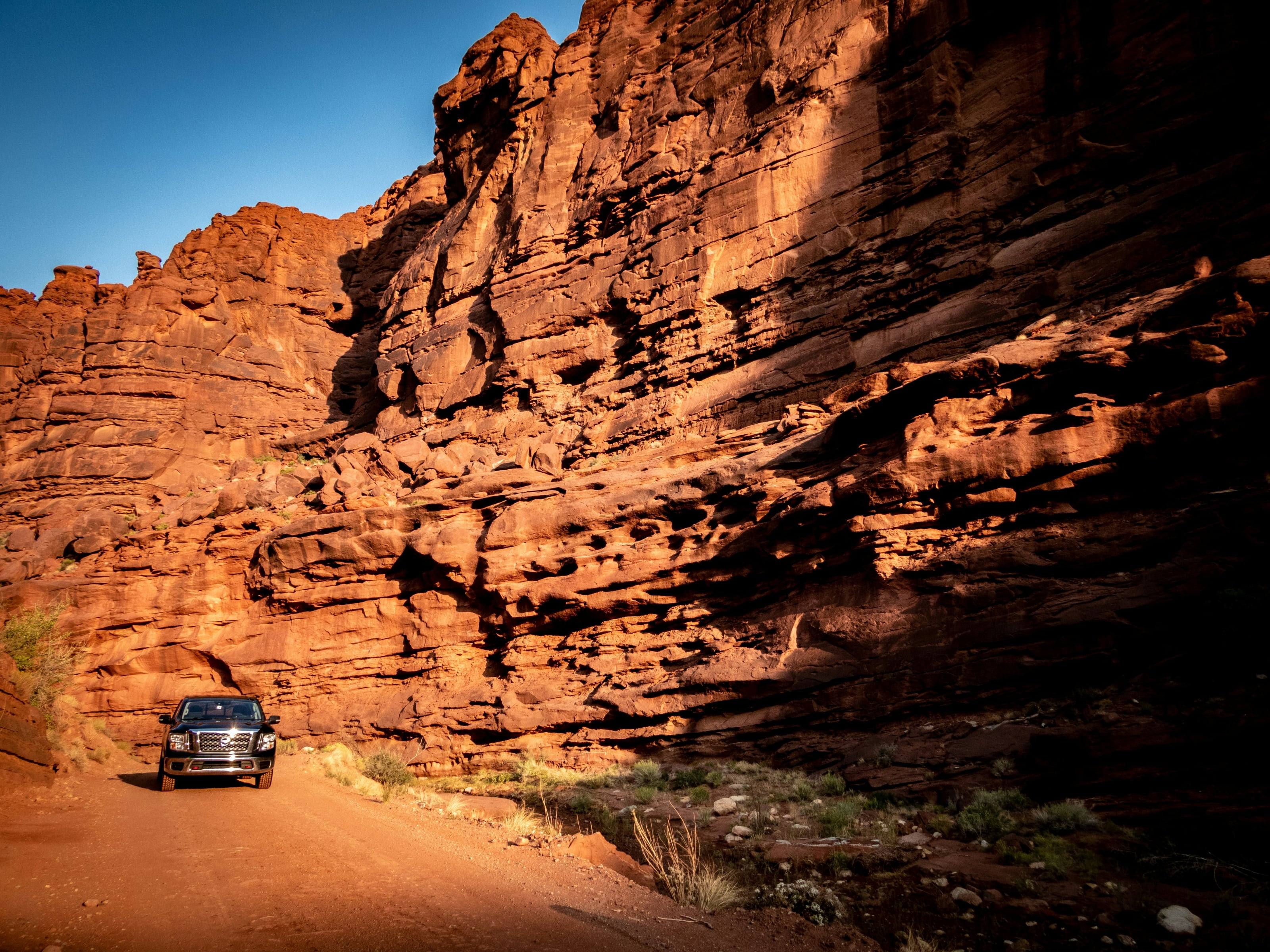
NPS’s wording shifts from page to page, and the shifts are the point. The Cathedral Valley page says vehicles with high ground clearance, even without four-wheel drive, can usually negotiate the roads. The Roads page says the ford may require a high-clearance or high-clearance four-wheel-drive vehicle, and that on the Hartnet Road high clearance is recommended at best. The campground page says high-clearance four-wheel drive is usually necessary to reach Cathedral Valley Campground.
Read together: high clearance is the minimum in good conditions, four-wheel drive is the margin, and no vehicle is enough when the clay is wet. NPS says rain and snow can leave these roads impassable to the best high-clearance four-wheel-drive vehicle.
ATVs and UTVs are prohibited in Capitol Reef, including street-legal ones, and vehicles must stay on established roads and pullouts. The Cathedral Valley page lists what to carry: plenty of water, food, gas, adequate clothing, a shovel and emergency supplies.
Source 2
Camping and permits
Inside the park, vehicle camping is allowed only at established campgrounds, and on this loop that means Cathedral Valley Campground. NPS lists six sites, each with a picnic table and fire grate, a pit toilet and no water. There is no fee and there are no reservations. Sites are first-come, first-served and limited to eight people and two vehicles.
It sits about halfway around the loop at roughly 7,000 feet, in the pinyon and juniper foothills of Thousand Lake Mountain, about 36 miles from the visitor center. NPS lists it as a year-round campground that weather can make inaccessible, so check road conditions before you plan a night there.
Fires are allowed only at the campground, in the fire rings provided or in a portable fire pan that contains all the ash. Collecting wood is prohibited, like collecting anything else in the park.
NPS lists no permit for driving the loop. Backpacking is by free permit from the visitor center. For entrance fees and passes, see the park’s fees page.
Source 4
Fuel, water and distances between services
No potable water is available in Cathedral Valley. Carry all of it.
There is no gas station in the park. NPS says the nearest fuel is in Torrey, 11 miles west of the visitor center, and in Hanksville, 37 miles east. The loop adds 57.6 miles with no services, and the River Ford map warns that the nearest services are hours away. NPS names Torrey as the closest town to the west and Hanksville to the east, and notes that many local businesses close in the winter off-season and on Sundays all year, so confirm before you go.
Cell service is not available in the park, NPS says, and the nearest is in Torrey. In Cathedral Valley it describes reception as usually poor to nonexistent.
Source 5
Hazards and season
Weather decides this route. NPS says flash floods are most common in July, August and September, can occur at any time of year, and can arrive under a clear sky when the rain falls outside the park.
Bentonite is the local hazard. NPS explains that the clay in the Bentonite Hills absorbs water and becomes very slick and gummy when wet, making vehicle or foot travel difficult or impossible. The River Ford map adds that these roads are maintained infrequently, are not plowed in winter, and can hold deep, soft sand.
The Cathedral Valley page says summer days may reach the upper 90s Fahrenheit and winter highs may stay below freezing, and that sudden storms, or an unexpected night out, bring cool or cold temperatures with them.
The park’s own list for this district: check forecasts and road reports before you leave, tell someone your plan, have a plan for self-rescue, never drive across a flooded road, and do not camp in dry washes.
Do not skipNPS warns that even small amounts of precipitation can make park roads completely impassable, and that a tow truck may take hours to reach you. If the forecast is wet, do not start.
Source 6
Leaving it as you found it
The rules NPS prints on its River Ford map are short.
- 01Vehicles stay on established roads and pullouts.
- 02Leave rocks, plants, wood, bones, antlers and artifacts where they are. Collecting is prohibited, and that includes the selenite at Glass Mountain.
- 03Pets stay on a leash of six feet or less, and only where vehicles are allowed: roads, pullouts, parking areas and campgrounds.
- 04Do not feed or disturb wildlife.
- 05No camping or off-road parking on the private land near the ford.
- 06Stay back from the edge of the Gypsum Sinkhole. NPS says the rock there is soft, unstable and can collapse at any time.
Source 3
Questions people ask
How deep is the Fremont River ford on the Cathedral Valley Loop?
NPS says water at the ford is normally a foot deep or less, over a hard packed, rocky bottom. It says not to attempt it during floods or high water, and to ask at the visitor center or call 435-425-3791 about ford conditions.
Do I need four-wheel drive for the Cathedral Valley Loop?
Not always. NPS says high-clearance vehicles, even without four-wheel drive, can usually negotiate the roads. Its River Ford map says four-wheel drive is often recommended, and wet weather can make the roads impassable to any vehicle.
How long does the Cathedral Valley Loop take?
NPS says the 57.6-mile loop takes about six to eight hours, before side trips and hikes.
Can I avoid the river ford?
Yes. The Cathedral Road end of the loop, 18.5 miles east of the visitor center, avoids the ford. NPS puts the Temple of the Moon 17.1 miles up that road, and you can return the same way.
Can I camp on the Cathedral Valley Loop?
Inside the park, only at Cathedral Valley Campground: six first-come, first-served sites with no fee and no water. NPS allows vehicle camping only at established campgrounds.
Where is the nearest fuel to Cathedral Valley?
NPS says the nearest fuel is in Torrey, 11 miles west of the Capitol Reef visitor center, and in Hanksville, 37 miles east. There is no gas station in the park.
 Bureau of Land Management (BLM)
 US Forest Service (USFS)
 National Park Service (NPS)
 US Fish and Wildlife (USFW)
 Bureau of Reclamation (USBR)
 Department Of Defense (DOD)
 Bureau of Indian Affairs (BIA)
 Other Federal
 State
 Local
 Alaska Native Lands (Patented or Interim Conveyed)
 Alaska Native Allotment
 Road
 Primitive Road
 Road
 Primitive Road
 Trail
 Roads open to all Vehicles, Yearlong
 Roads open to all Vehicles, Seasonal
 Roads open to highway legal vehicles only, Yearlong
 Roads open to highway legal vehicles only, Seasonal
 Special Designation, Yearlong
 Special Designation, Seasonal
 Trails open to all vehicles, Yearlong
 Trails open to all vehicles, Seasonal
 Trails open to vehicles 50" or less in width, Yearlong
 Trails open to vehicles 50" or less in width, Seasonal
 Trails open to motorcycles, Yearlong
 Trails open to motorcycles, Seasonal
 Special Designation, Seasonal
 Trails Open to Wheeled Vehicles Only < 50" in Width, Yearlong
 Trails Open to Wheeled Vehicles Only < 50" or Less in Width, Seasonal
 Wilderness Area
 Wilderness Study Area